
As we navigate 2026, the United States’ digital infrastructure is undergoing a historic shift. Fueled by massive federal investments like the Broadband Equity, Access, and Deployment (BEAD) program, tier-2 and tier-3 internet service providers (ISPs), regional data centers, and enterprise network architects are actively seeking optimized hardware to extend high-speed connectivity to the deepest edges of the network. Navigating this upgrade cycle requires balancing capital expenditure with uncompromising reliability. The ubiquitous 10G SFP+ optical transceiver remains the gold standard for metro access, wireless front-haul, and edge routing environments.
- The Core Advantage: 10G SFP+ modules balance performance, low thermal footprint, and deployment economics compared to next-generation AI optics.
- Innovative Signal Tuning: The proprietary Optone Intelligent Control Protocol dynamically self-corrects optical degradation across expansive fiber loops.
- Rugged USA Deployments: Outdoor nodes require rigorous IP67/IP68 sealing and strict adherence to SFF-8431 and MSA parameters for multi-vendor interoperability.
- Sourcing Strategy: Sourcing high-quality optical modules from responsive, transparent partners with instant US logistics avoids the supply chain bottlenecks of 2026.
Executive Summary & Key Takeaways: Bridging the US Connectivity Gap for Rural ISPs and Edge Computing
The bridging of the US connectivity gap is no longer an abstract engineering debate—it is an active commercial mandate. From rural cooperative utilities in the Midwest to ultra-low-latency edge nodes along the West Coast, network engineers are facing identical challenges: legacy infrastructure must handle increasingly dense optical workloads. While the hype cycle focuses on extreme 800G and 1.6T speeds in central AI hubs, the real-world connectivity bottleneck is solved at the edge. Optone’s suite of 10G SFP+ optical transceivers provides the mechanical and electrical answer, delivering highly efficient throughput with exceptionally low power consumption and versatile range profiles across SR, LR, ER, ZR, CWDM, DWDM, and BIDI spectrums.
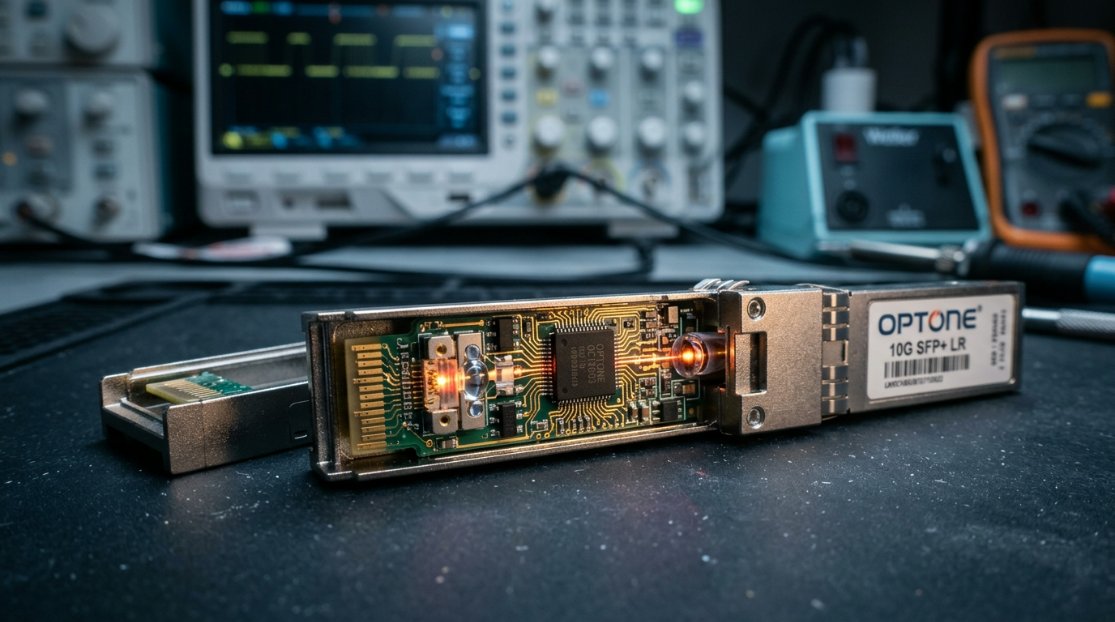
Core Technology: Unveiling the Proprietary Optone Intelligent Control Protocol for Superior Signal Integrity
At the heart of Optone’s premium performance is our proprietary engineering layer: the Optone Intelligent Control Protocol. Standard optical transceivers suffer from linear degradation as temperatures swing wildly inside unconditioned roadside cabinets. Our innovative, built-in control framework leverages an embedded microprocessor that monitors dynamic internal conditions—including laser bias current, temperature fluctuations, and supply voltage—using highly accurate digital diagnostic monitoring (DDM) compliant with the SFF-8472 industry standard.
By using the Optone Intelligent Control Protocol, the transceiver auto-tunes its transmitter optical eye diagram in real-time, drastically reducing chromatic dispersion and optical jitter. This active signal tuning guarantees consistent, zero-error packet transmission even over extended 80km runs on aging Single-Mode Fiber (SMF). This ensures rural network installations operate flawlessly year-round without requiring costly physical technician call-outs for signal recalibration.
Practical Step-by-Step Tutorial: 4-Step Direct Installation and Waterproof Resealing Process for Outdoor Edge Nodes
To achieve maximum uptime in outdoor US environments—such as pole-mounted 5G small cells or industrial IoT gateways—follow this rigorous installation and sealing checklist.
Step 1: Inspecting MSA Compliance and Verifying Transceiver Pin Alignment
Before slotting the hardware, confirm that the module matches MSA, SFF-8472, and SFF-8431 engineering parameters. Gently inspect the 20-pin gold-plated card-edge connector at the rear of the Optone 10G SFP module for particulate contamination. Use an optical cleaning pen to clean both the module transceiving ports and the incoming LC patch cable connectors.
Step 2: Engaging the Optone-Sync Precision Protocol Auto-Latch Mechanism
Align the transceiver with the target SFP+ slot on your switch or media converter. Keeping the bale clasp closed, gently push the module in until you hear a distinct physical click. This engages the Optone-Sync Precision Protocol auto-latch, confirming an optimal, dust-sealed electrical interface with zero mechanical float.
Step 3: Measuring Exact Fiber Cutting Intervals (Spacing Per Meter) for Optimal Splice Preparation
For custom fiber runs, measure precise fiber cutting intervals to limit macrobending and strain. Leave a minimum 1.5-meter expansion loop within your optical splice tray. This safe slack allows for environmental contraction during extreme winter cold spikes and prevents optical micro-fractures inside the outer cable jacket.
Step 4: Applying IP67/IP68 Waterproof Resealing Techniques for Hardened US Rural Deployments
For unconditioned outdoor enclosures, thread your LC duplex patch cable through an IP67/IP68 rated compression gland. Tighten the dome nut to compress the internal rubber grommet tightly around the fiber sheath. Apply a thin wrap of premium self-amalgamating weatherproofing tape over the joint line to keep out moisture, dust, and corrosive elements.
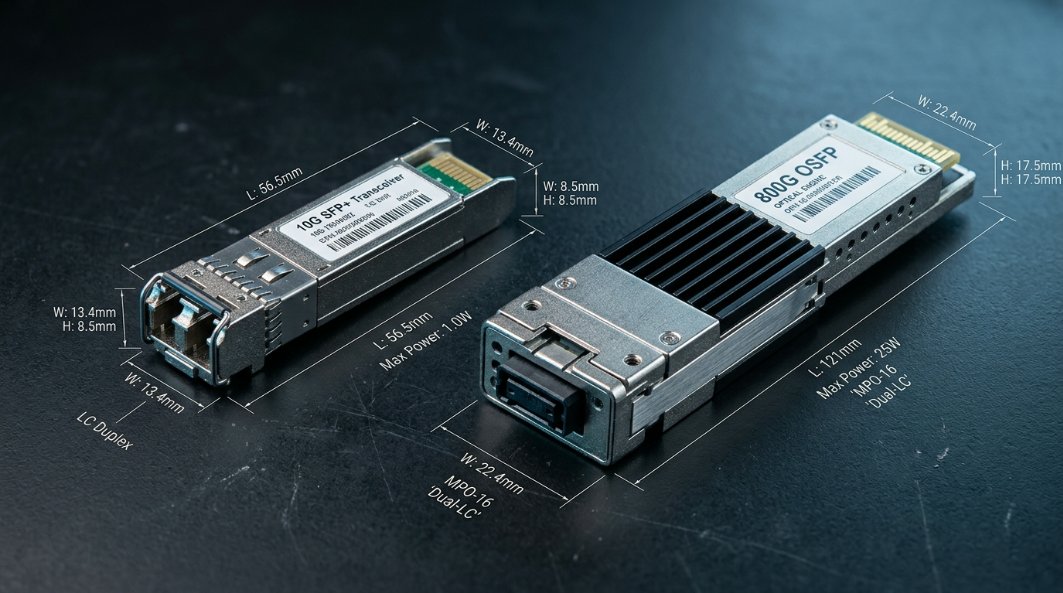
Technical Specification Guide & Comparison Matrix: Cost-Effective 10G SFP+ vs. High-Density 800G and 1.6T AI Optics
Selecting the correct hardware is key to maintaining a highly cost-effective and energy-efficient network footprint. Below is a detailed engineering comparison of 10G SFP+ compared to higher-tier high-density AI optical form factors:
| Specification Metric | Optone 10G SFP+ (SR/LR/ER/ZR) | 800G QSFP-DD / OSFP | 1.6T OSFP-XD AI Optics |
|---|---|---|---|
| Typical Power Consumption | < 1.0W to 1.5W (Ultra-Low) | 14.0W – 18.0W | 22.0W – 30.0W |
| Operating Temperature Options | Commercial (0~70°C) / Industrial (-40~85°C) | Commercial (0~70°C) only | Commercial (0~70°C) only |
| Reach Options | 300m (SR) up to 80km (ZR) & 120km (Custom) | 100m to 10km max | 50m to 2km max |
| Deployment Complexity | Low (Plug-and-Play, highly backwards compatible) | High (Complex heat sink & cooling requirements) | Extreme (Liquid cooling / specialized racks) |
| Best Use Case | Metro, Edge Computing, Wireless, ISP Backhaul | Hyperscale AI clusters, core data centers | AI Training Clusters, deep high-performance computing |
Mathematical & Electrical Calculation Guidance: Exact Wattage Formulas and Power Supply Load for Custom Fiber Runs
To avoid overloading the power supplies on small-scale switches or fanless edge gateways, you must accurately budget thermal and electrical thresholds. The total wattage of your optical ports can be calculated using the following engineering formula:
// Formula for Total Optical Port Power Load
P_total = (N_SR * P_SR) + (N_LR * P_LR) + (N_ZR * P_ZR) + P_safety_margin

Where:
- N_xx = Number of active channels/modules deployed
- P_SR = Power rating of SR modules (typically 0.8W)
- P_LR = Power rating of LR modules (typically 1.0W)
- P_ZR = Power rating of long-reach ZR modules (typically 1.5W)
- P_safety_margin = 15% minimum safety overhead (factor of 1.15)

// Sample Calculation for a 24-Port Switch with 4x 10G SFP+ ER modules:
P_total = (4 * 1.2W) * 1.15
P_total = 4.8W * 1.15 = 5.52 Watts

Ensure this value does not exceed the dedicated aux-power allotment of your host switch motherboard backplane.
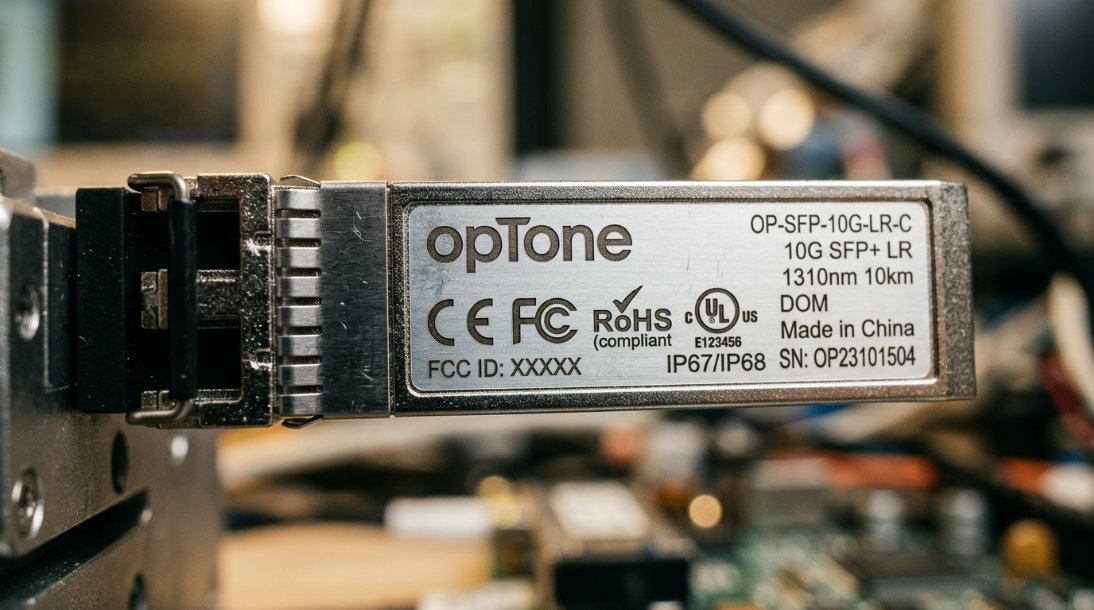
US & International Regional Standards: Ensuring UL, CE, RoHS, FCC, and IP67/IP68 Flex Certification Compliance
For network designs looking to secure state-level and federal US funding (such as BEAD), every component must comply with international and domestic regulatory frameworks. Optone transceivers conform to UL safety requirements, hold CE marks, and strictly limit hazardous substances in line with RoHS guidelines. Crucially, they are tested under FCC Part 15 Class B standards to prevent electromagnetic interference (EMI) with adjacent wireless cells, guaranteeing clean communications for commercial networks.
Frequently Asked Questions (FAQ): Smart Integrations, Tolerances, and Network Safety Instructions
How does a 10G SFP+ edge network backbone support and minimize latency for Smart Home ecosystems (Matter standard, Apple HomeKit, Amazon Alexa)?
Smart home standards like Matter process data locally to speed up execution times. However, cloud integration, device provisioning, and cross-subnet routing still depend on a fast, reliable local backbone. Backhauling residential and regional access networks via high-speed, low-power 10G SFP+ links ensures that traffic from smart home devices reaches the local edge server with negligible latency, preventing bottlenecking at the regional routing level.
What are the precise cutting tolerances and minimum bend radius safety instructions for fiber optic cables connected to these modules?
Standard single-mode G.652.D fiber cables require a minimum dynamic bend radius of 20 times the cable’s outer diameter during installation, and 10 times the outer diameter once secured in place. Exceeding these limits causes light leakage (macrobending loss), which degrades your signal and trigger warnings via the transceiver’s built-in DDM dashboard.
Why is transparent B2B pricing and immediate US stock critical for bypassing 2026 supply chain bottlenecks?
With infrastructure upgrades accelerating across the United States, project timelines frequently stall due to delays in receiving components. Accessing clear B2B pricing and deep, local inventory in the US allows municipal networks and private companies to confidently budget and execute deployments without the risk of long customs holds or unexpected price spikes.
Looking for Custom Engineering/OEM Solutions?
As a top-tier professional manufacturer, we deliver direct factory-price solutions for dynamic scaling, engineering projects, and custom systems globally.
Need help selecting the right product?
Share your switch platform, link distance and quantity with an OPTONE engineer.
Talk to an Engineer →