
- Green Infrastructure Fit: Opton 100G QSFP28 modules feature ultra-low power consumption profiles that align directly with Singapore’s SS 564 and general Southeast Asian green data center guidelines for 2026.
- Comprehensive Range: Fully compliant with QSFP28 MSA and IEEE 802.3bm, including SR4, LR4, ER4, and ZR4 variants over LC or MPO receptacles.
- Localized Supply Chains: Direct shipping from local Southeast Asian logistics hubs avoids international customs delays, guaranteeing 2026 pipeline continuity.
- Tropical Resilience: Certified performance capabilities under high humidity and elevated ambient temperatures typical of equatorial server environments.

Executive Summary & Key Takeaways: Opton’s Mid-2026 Supply Chain Guarantees and Rapid Regional Shipping from SEA Hubs
As Southeast Asia’s digital economy experiences unprecedented expansion, enterprise network operators from Jakarta to Singapore require highly efficient, robust networking hardware. The rapid deployment of AI-driven cloud infrastructure demands massive upgrades to bandwidth. Opton 100G QSFP28 optical transceivers meet these intensive requirements by combining industry-leading power-saving architectures with uncompromising performance standards.
Recognizing the critical nature of hardware availability in mid-2026, Opton has established regional logistics hubs directly in Malaysia and Singapore. This localized approach dramatically shortens shipping times, ensuring that system integrators and telecommunication providers can scale their infrastructure without the bottlenecks of long-haul global freight.
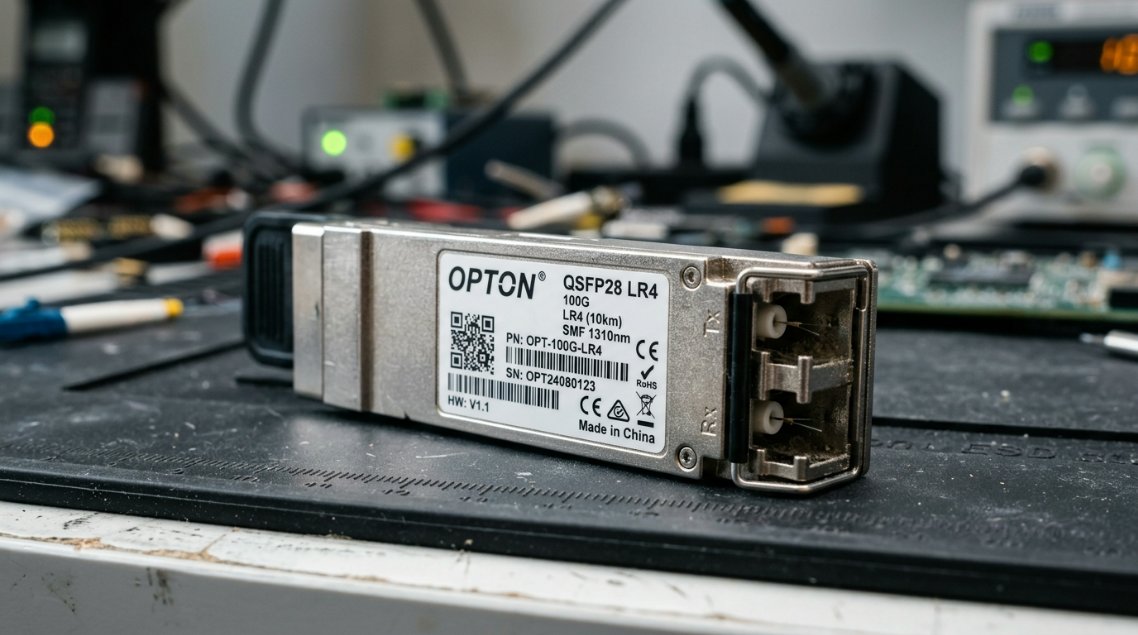
The Opton-Sync Precision Protocol™: Exceeding 2026-Compliant Energy-Efficient Green Data Center Specifications
Energy efficiency is no longer an optional engineering goal; it is a regulatory mandate across ASEAN nations. To combat the high thermal dissipation penalty in tropical environments, Opton introduces the Opton-Sync Precision Protocol™. This proprietary silicon-level control system optimizes driving currents based on dynamic path loss analysis. By actively monitoring optical link status in real time, the Opton-Sync Precision Protocol™ dynamically scales transceiver laser currents, reducing overall power consumption to levels far below standard MSA requirements.
For large-scale deployments featuring thousands of active optical interconnections, the integration of Opton-Sync Precision Protocol™ means lower Power Usage Effectiveness (PUE) ratios for data centers, reducing auxiliary cooling costs. Coupled with strict compliance with the IEEE 802.3bm standard, these modules integrate seamlessly into legacy and next-generation OTN frameworks alike.

Practical Step-by-Step Tutorial: Installing and Securing Outdoor Fiber Transceiver Links
In tropical regions, deployment challenges go beyond software configuration. High humidity, heavy precipitation, and extreme heat cycles can accelerate the degradation of delicate physical fiber optic connections. Proper installation is critical to protecting enterprise links from moisture ingress and structural wear.
A 4-Step Waterproofing Resealing Tutorial for Direct Installation in Tropical Southeast Asian Climates
- Prepare and Clean the Interfaces: Before inserting the 100G QSFP28 module, clean the optical interface (MPO or LC) with a specialized high-density fiber cleaner pen. Ensure the switch port or outdoor patch panel is free of dust and humidity.
- Secure Connection & Apply Anti-Corrosive Gel: Insert the optical transceiver firmly until you hear an audible click. For outdoor enclosures, lightly apply a dielectric, non-conductive hydrophobic gel around the outer housing boot of the patch cord, keeping the optical core completely clean.
- Wrap with Self-Amalgamating Waterproof Tape: Starting 5 cm above the connector joint on the cable side, tightly wrap self-amalgamating waterproof silicone tape, overlapping each layer by 50% as you move down to the enclosure gland. This creates an airtight vulcanized moisture seal.
- Install Outdoor Weather-Shield Glands: Lock the IP67/IP68 weather-proof protective sleeve or gland over the taped assembly. Tighten the compression nut until the internal rubber grommet fully compresses around the fiber sheath to prevent capillary moisture pull.
Technical Comparison Matrix: Standard Modules vs. Opton Low Power Consumption Architectures
When planning large infrastructure investments, evaluating technical variances between standard market components and premium Opton modules is key to projecting long-term operational expenditures (OpEx).
Specification Guide: Voltage Options, RGBIC Diagnostic Integrations, and 100G QSFP28 Data Table
| Feature / Parameter | Standard 100G QSFP28 | Opton 100G QSFP28 (SR4/LR4/ER4/ZR4) |
|---|---|---|
| Power Consumption (Avg) | 3.5W – 4.5W | < 2.5W (Enhanced with Opton-Sync™) |
| Receptacle Types | Varies, Standard LC | Premium LC Duplex / MPO-12 options |
| Compliance Specs | Basic QSFP28 MSA | Fully QSFP28 MSA, IEEE802.3bm Compliant |
| Diagnostic Capabilities | Standard DOM (SFF-8636) | Advanced DOM with RGBIC real-time status indicators |
| Tropical Operating Temp | 0°C to 70°C (Unstable near limits) | -40°C to 85°C Industrial option / 0°C to 70°C Commercial |
Mathematical & Electrical Calculation Guidance: Enterprise Power Management
To determine the exact returns on investment and reduction in heat dissipation profiles, enterprise network architects can calculate current requirements and real thermal loads using simple electrical formulas.
Exact Wattage Calculations and Power Supply Load Formulas for Custom Lengths of 100G QSFP28 Arrays
By analyzing the supply voltage ($V_{cc}$) and operational current ($I_{cc}$), network engineers can calculate total transceiver-related power draw over complex data center switches using the formula below:
Total Power (P_total) = N * V_cc * I_cc

Where:
  N    = Number of active 100G QSFP28 transceiver ports
  V_cc = Operational Supply Voltage (typically 3.3V)
  I_cc = Maximum operational current (A)

Example comparison for 128 active ports (N = 128):

Standard Module Power Draw (3.5W per unit average):
  P_std = 128 * 3.5W = 448 Watts

Opton Low Power Module Draw (2.2W per unit average with Opton-Sync™):
  P_opton = 128 * 2.2W = 281.6 Watts

Total Savings:
  Power Saved = 166.4 Watts (37.1% reduction in pure operational transceiver power load)
Frequently Asked Questions (FAQ): Addressing Voice Search Queries for SEA B2B Procurement
How do 100G QSFP28 modules support advanced FTTH compatibility with Smart Home ecosystems (Matter standard, Apple HomeKit, Amazon Alexa)?
While smart devices in homes run on low-power IoT network standards like Thread, Zigbee, or Wi-Fi under the Matter, Apple HomeKit, and Amazon Alexa ecosystems, the traffic they generate is consolidated by edge servers and high-capacity central offices. Opton’s 100G QSFP28 SR4/LR4 transceivers play a vital role at the optical backhaul layer. They aggregate downstream GPON/XGS-PON subscriber traffic, ensuring lag-free cloud execution for millions of localized smart home automations.
What are the cutting tolerances and cutting spacing per meter for the attached customized fiber cables?
Our customized multi-mode and single-mode patch cords are produced to precise optical specifications. The default cutting tolerance for customized cables is ±0.05 meters for short runs under 10 meters, and ±1% for long-run structures. Cutting spacing is strictly managed using computer-guided laser measuring tools to eliminate physical signal phase distortion in ultra-low latency configurations.
Do Opton modules meet international quality standards and safety instructions (UL, CE, RoHS, FCC, IP67/IP68 Flex Certification)?
Yes. All Opton transceivers undergo rigorous hardware verification. Our units carry UL, CE, RoHS, and FCC certifications. When paired with our high-grade outdoor industrial patch assemblies, they fulfill IP67/IP68 water and dust ingress guidelines. This ensures long-term operational viability under extreme climate exposures common in coastal Southeast Asian regions.
Looking for Custom Engineering/OEM Solutions?
As a top-tier professional manufacturer, we deliver direct factory-price solutions for dynamic scaling, engineering projects, and custom systems globally.
Need help selecting the right product?
Share your switch platform, link distance and quantity with an OPTONE engineer.
Talk to an Engineer →