
Many network architects assume that plugging a non-OEM cable into a $30,000 core switch is a fast track to network failure. Network equipment vendors aggressively push this idea. They want you buying their branded twinax and active optical assemblies at a massive markup, often warning that third-party optics will compromise your uptime.
Yes, third-party AOC and DAC cables are completely safe for enterprise data centers. The hardware inside a Cisco, Arista, or Juniper branded cable is built to the exact same physical and electrical specifications as a high-quality third-party alternative. The primary difference is the logo stamped on the pull tab and the vendor string written to the onboard memory chip. When sourced from a reputable manufacturer, third-party cables deliver identical bit error rates and thermal performance at a fraction of the cost.
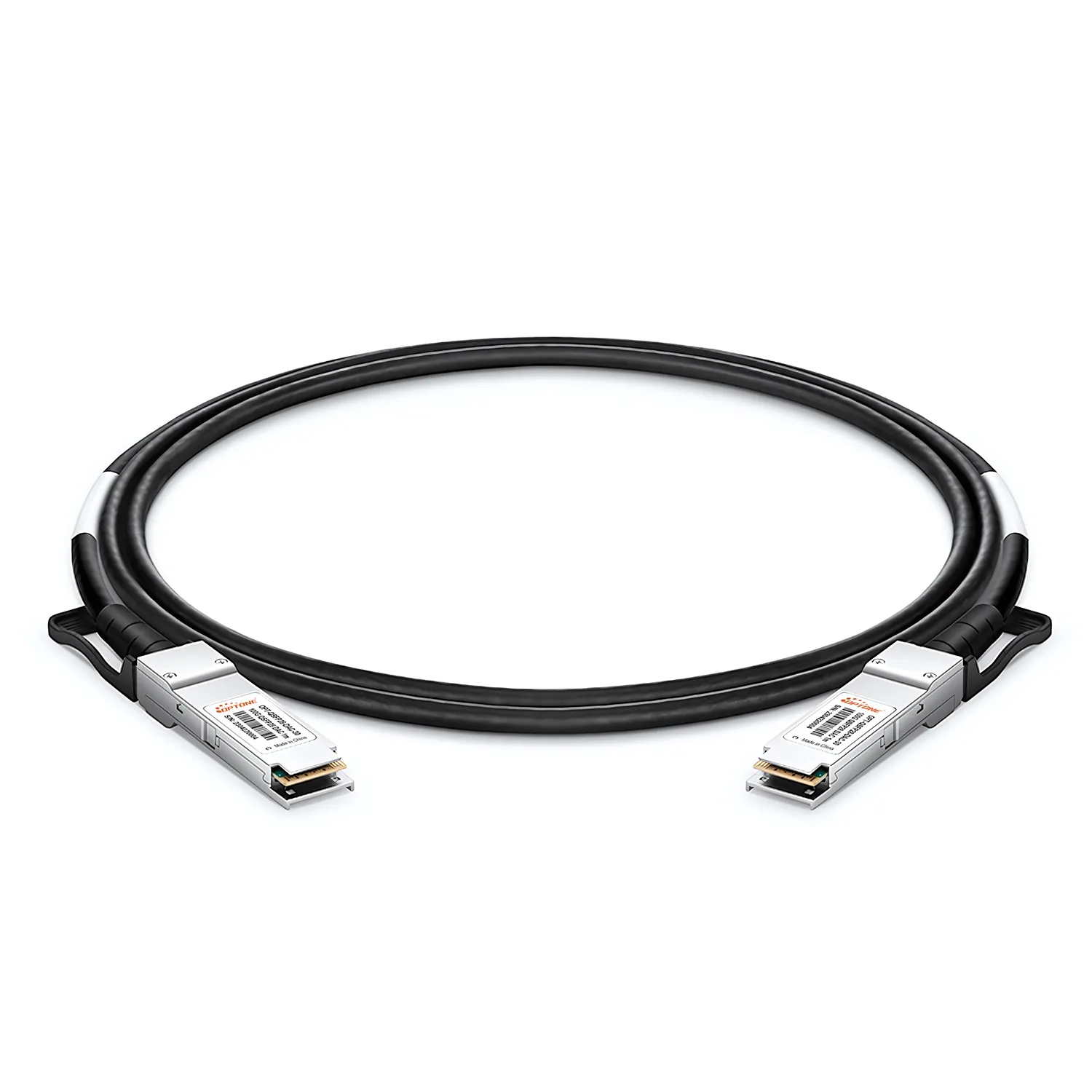
The OEM Vendor Lock-In Myth vs. MSA Compliance Reality
No major switch manufacturer builds their own optics or copper interconnects from scratch. They rely on the Multi-Source Agreement (MSA). This is a joint framework established by the networking industry—managed through committees like the SFF (Small Form Factor) Committee—that defines the mechanical dimensions, electrical interfaces, and thermal tolerances for every connection type from SFP+ to QSFP-DD.
OEMs purchase their cables from specialized optical foundries, lock the firmware, and re-sell them. When you procure AOC & DAC cables directly from a factory-direct manufacturer like OPTONE, you are buying hardware that physically matches the OEM product. The MSA standard strictly prevents physical incompatibility. If a 400G QSFP-DD cable meets MSA specifications, it will fit the port housing precisely, draw the correct voltage, and interface cleanly with the switch’s electrical lanes.
The MSA dictates everything down to the insertion force required to seat the module and the specific pinout for high-speed data transmission. Because factory-direct manufacturers adhere to these exact same blueprints, the physical layer of your network remains identical whether the cable costs $150 or $800.
How EEPROM Coding Guarantees Switch Interoperability
If the hardware is identical, why do switches sometimes reject third-party cables? The answer lies in a tiny memory component called the EEPROM (Electrically Erasable Programmable Read-Only Memory).
When you insert a cable, the switch operating system reads the EEPROM via an I2C management interface. It checks specific memory addresses defined by the MSA—typically starting at Page 00h—to find the vendor identifier string, the part number, and the serial data. If an HP or Cisco switch reads a generic string instead of its expected proprietary code, the OS throws an “unsupported transceiver” error and deliberately disables the port’s TX/RX lanes.
This is a software lockout, not a hardware failure.
Reputable third-party manufacturers bypass this by programming the EEPROM to perfectly mirror the OEM’s required identifiers. OPTONE engineers write the specific compatibility codes directly onto the cable’s chip at their Shenzhen facility before shipping. The switch reads the EEPROM, sees the expected handshake, and brings the link up instantly. There is no software hacking or network manipulation involved. It is a standard compliance check, fulfilled exactly as the switch expects.
Scaling Rack Density with Custom Lengths and Breakout Assemblies
Off-the-shelf OEM cables usually ship in rigid length increments: 1 meter, 3 meters, or 5 meters. That works fine in a test lab. In a fully populated top-of-rack deployment, an extra 1.5 meters of thick twinax cable creates a physical nightmare. It blocks airflow, traps exhaust heat, and puts severe mechanical stress on the switch ports.
Procuring factory-direct allows you to specify custom length DAC cables down to the exact decimeter. You get just enough slack to route neatly through vertical cable managers without choking the server exhausts. Managing bend radius is critical here. A 1-meter DAC might use thin 30AWG wire, making it relatively flexible. To push 400G over 3 meters, manufacturers must use thicker 26AWG or 24AWG twinax. This thicker cable is stiff. Bending it past its minimum radius crushes the dielectric insulator, altering the impedance and causing signal reflections that destroy network throughput.
This flexibility extends to QSFP-DD breakout assemblies. Splitting a single 400G port into four 100G QSFP28 connections increases port density without adding another switch layer. Buying exact-length breakout cables prevents a tangled mass of copper that makes hot-swapping servers impossible.
Preparing Backend Networks for 2026 AI Clusters
GPU clusters are fundamentally changing rack architecture. You cannot run standard leaf-spine topologies when a single AI training rack draws 40kW and demands non-blocking, lossless Ethernet or InfiniBand. High-frequency trading and AI interconnects require zero packet loss and predictable latency.
For these environments, 400G QSFP-DD AOC assemblies are becoming mandatory. As link speeds increase to 400G and 800G, signals rely on PAM4 (Pulse Amplitude Modulation 4-level) encoding. PAM4 is highly susceptible to noise over copper at longer distances. Active Optical Cables eliminate this electromagnetic interference entirely. They provide the necessary bandwidth while keeping cable bulk low enough to allow massive rear-door heat exchangers to function without obstruction.
Common Concerns About Third-Party Interconnects
Do Third-Party Cables Void OEM Switch Warranties?
No. This is the single most common misconception in enterprise network procurement. In the United States, the Magnuson-Moss Warranty Act prohibits manufacturers from voiding a hardware warranty simply because you used a third-party peripheral. Major vendors explicitly state in their official policies that using third-party optics does not void their hardware support.
If a switch port fails, the vendor must prove the third-party cable caused the physical damage. Since MSA-compliant cables operate within identical electrical and thermal tolerances as OEM cables, a transceiver physically damaging a switch port is exceptionally rare. If a software bug occurs, the OEM support team may ask you to swap in an OEM optic to replicate the issue, but they cannot cancel your service contract for using third-party interconnects.
Latency and Power Trade-Offs Between Twinax DACs and AOCs
Choosing between a Direct Attach Copper (DAC) and an Active Optical Cable (AOC) forces a strict decision between weight, power draw, and reach.
DAC cables are passive components. They draw near-zero power (frequently under 0.1W per end) and introduce essentially zero latency, making them the absolute best choice for server-to-top-of-rack connections where nanoseconds matter. The trade-off is distance and weight. A passive 400G DAC is thick and heavy, and typically maxes out at 2.5 to 3 meters before signal degradation ruins the bit error rate, forcing the switch to drop packets.
AOCs embed the optical transceiver directly into the cable ends. They convert the electrical signal to light, pushing data up to 100 meters over OM4 multimode fiber. They are significantly lighter, dramatically reducing cable tray weight and improving rack airflow. The penalty is power consumption. A 400G AOC can draw up to 10W to 12W per end. Across a fully populated 128-port spine switch, that active thermal load adds up fast, requiring more aggressive cooling from the facility.
Transitioning to Factory-Direct Procurement for Network Upgrades
Switching away from OEM cables requires a methodical approach, not a blind swap. Start by running third-party cables in your secondary data centers, management networks, or non-critical storage clusters. Monitor the bit error rates, Forward Error Correction (FEC) logs, and thermal output over a 90-day cycle. Verify that your network management tools read the optical diagnostic monitoring (DOM) data correctly.
Once you prove interoperability in your own environment, scale up. Buying 10G to 400G AOC and DAC cables factory-direct from OPTONE strips out the extreme distributor markups while maintaining strict MSA compliance and custom EEPROM coding. You get the exact same physical link reliability and OEM compatibility, but with a procurement model that leaves budget available for actual compute and switching upgrades.
Need help selecting the right product?
Share your switch platform, link distance and quantity with an OPTONE engineer.
Talk to an Engineer →