
A 400G uplink can fail for a surprisingly ordinary reason: the module arrived with the wrong fiber interface, the host port rejected its EEPROM coding, or the installed cabling cannot support the selected optical variant. The carton may still say “400G QSFP-DD.” That is not enough.
For buyers sourcing China optical transceivers into data-center, telecom, ISP, and enterprise networks, the useful question is not simply who can quote a low module price. You need to establish the optical architecture, host-platform behavior, management requirements, documentation trail, and acceptance test before the purchase order is released. OPTONE Technology Limited has operated from Shenzhen since 2003 and supplies optical transceivers across form factors from 1G through 800G, alongside AOC/DAC cables, media converters, and fiber Ethernet switches. Its 400G QSFP-DD range includes SR8, DR4, FR4, and LR4 choices for materially different link designs.
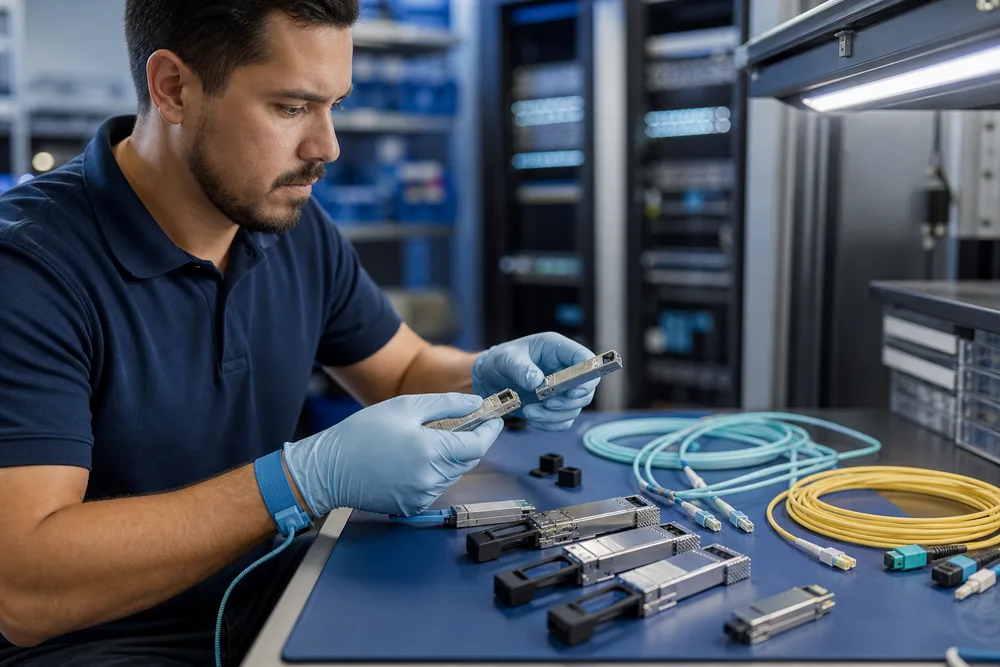
Key Takeaways for Selecting and Sourcing 400G QSFP-DD Optical Transceivers
- Choose SR8, DR4, FR4, or LR4 from the installed fiber plant and intended link architecture, not from module price alone.
- Confirm the host switch or router model, operating-system release, port mode, and required vendor coding before ordering.
- Ask for the exact connector, fiber type, optical reach class, CMIS information, and DDM requirements in the quotation request.
- Use pre-shipment compatibility and basic communications checks to catch coding, management, and labeling errors before site delivery.
Start with the physical plant. Short-reach multi-mode deployments and single-mode structured cabling do not call for the same 400G optic; nor does a parallel-fiber link have the same connector and polarity exposure as a duplex single-mode link. A module selection that looks interchangeable on a spreadsheet can force a field rework involving trunks, cassettes, patch cords, or an entire cross-connect plan.
Then check the host side. QSFP-DD describes a pluggable form factor, but the switch’s software, port configuration, and vendor acceptance policy still decide whether a given optic will operate as intended. This is where experienced purchasers separate an actionable quote from a generic one. Provide the precise OEM platform and ask the supplier to state the compatibility target in writing.
OPTONE’s published portfolio identifies QSFP-DD MSA, CMIS, I2C, DDM, and PAM4 among the relevant 400G terms. Those are not decorative datasheet keywords. They affect mechanical fit, host communication, field visibility, and the practical ability to diagnose a marginal link.
400G QSFP-DD Variant Comparison: SR8, DR4, FR4 and LR4 Selection Criteria
The four names describe different optical approaches, and buyers get into trouble when they treat them as reach labels only. SR8 is associated with short-reach, parallel multi-mode operation. DR4 is a parallel single-mode option. FR4 and LR4 use four optical lanes over duplex single-mode fiber, making them relevant where a duplex LC-style structured-cabling path is already in place. The correct choice follows the fiber type, connector path, link distance category, and whether parallel or duplex connectivity is workable in your facility.
SR8 may be a sensible fit inside a short-reach multi-mode environment, but it is not a substitute for a single-mode design. DR4 can suit a parallel single-mode path, yet its MPO connection and polarity arrangement deserve a deliberate review at both ends. FR4 and LR4 can reduce disruption where duplex single-mode patching is the established standard, but they are separate reach classes and must be selected against the actual channel requirement, including patch panels and intermediate connections.
| 400G QSFP-DD option | Fiber approach | Typical connector pattern | Selection focus |
|---|---|---|---|
| SR8 | Parallel multi-mode | MPO | Short-reach multi-mode channel and correct polarity |
| DR4 | Parallel single-mode | MPO | Parallel single-mode architecture and lane mapping |
| FR4 | Duplex single-mode | LC | Duplex single-mode path and required reach class |
| LR4 | Duplex single-mode | LC | Longer single-mode requirement and total channel condition |
Verify connector details against the selected module datasheet rather than relying on a family name alone. That small step avoids one of the most expensive “minor” errors in a 400G rollout: optics arrive correctly coded and electrically sound, while the installed patching physically cannot mate with them.
How to Match a 400G QSFP-DD Module to Fiber, Connector, Reach and Network Architecture
Walk the route from the switch faceplate to the remote port. Record the fiber medium, every connector transition, existing cassette type, patch-cord construction, and the intended active equipment at each end. Do not base the choice on the nominal building-to-building or rack-to-rack distance alone. Channel loss, connector cleanliness, and the number of mated interfaces all matter, particularly where an older structured-cabling system has accumulated changes over time.
Multi-mode and single-mode fiber are the first fork in the decision. From there, determine whether your route is built around parallel MPO connectivity or duplex LC connectivity. A parallel design makes lane continuity and polarity part of the commissioning task. A duplex design has a simpler front-panel connection, but it still requires the right single-mode optical class for the route. You should also establish if the switch port will run native 400G and whether the network design has any breakout or port-mode constraints that affect the module choice.
Ask the site team for photos of the patch fields if cabling records are doubtful. This is often faster than arguing over a stale cable schedule. Confirm that the remote end uses the same optical standard and that both devices can accept the proposed coding. For current product availability and option review, see OPTONE’s 400G QSFP-DD optical transceiver range.
Avoid assuming that a higher-reach optic is automatically the safer purchase. It may cost more, may not suit the intended design, and does not cure a mismatched connector, bad polarity, unsupported host, or contaminated end face. Match the optic to the actual channel.
How to Request an Accurate 400G QSFP-DD Quote: A Step-by-Step Buyer Checklist
A good request for quotation gives the supplier enough information to quote the right module once. “Need 400G optics for Cisco” is not enough to establish a compatible part. The purchaser may know the vendor but omit the switch family, software state, fiber medium, or connector system—the items that decide what should ship.
- Identify both host endpoints. State the manufacturer, exact device model, relevant port type, and software or operating-system version where available.
- Name the required 400G option. Specify SR8, DR4, FR4, or LR4 if the design is set; otherwise describe the fiber, connector, and route so the option can be assessed.
- Describe the physical channel. State multi-mode or single-mode fiber, MPO or LC presentation, approximate route category, and any panels, cassettes, or adapters in the path.
- Set compatibility expectations. Tell the supplier which OEM coding is required and whether third-party-transceiver restrictions or platform alarms are a concern.
- Request supporting records. Ask for the datasheet, label convention, DDM/CMIS information where needed, test scope, quantity, delivery destination, and packaging requirements.
Quantity matters beyond pricing. A pilot order may need a specific compatibility target and staged verification; a larger deployment needs consistent labeling, lot traceability, and a clear plan for replacements. If modules will be installed in geographically separate sites, say so early. Shipping, customs documentation, and site acceptance can be planned around that reality rather than improvised after dispatch.
For a structured starting point, send the requested details alongside the relevant 400G QSFP-DD product enquiry. It gives technical and commercial teams a shared reference before a part number is finalized.
OEM Compatibility, MSA Compliance and CMIS Management for 400G QSFP-DD Deployments
Compatibility has three layers: physical fit, electrical and management communication, and host-platform acceptance. A module can seat correctly in a QSFP-DD cage yet still raise an unsupported-transceiver message, expose incomplete diagnostics, or behave differently after a switch software update. Specify the actual host equipment, not just the OEM name.
OPTONE compatibility testing is the company’s stated approach to checking its optics against platforms including Cisco, Juniper Networks, Huawei, Arista Networks, Dell, HP/HPE, and other OEM equipment. Technically, that matters because the assessment is not limited to inserting a module into a port. The host must recognize the module through its management interface, read the expected identification and diagnostic fields, and permit the intended port operation. Buyers should ask which exact platform and software context is covered by the requested test, especially when using a less common chassis or a restrictive network operating system.
QSFP-DD MSA alignment addresses the common form-factor and interface expectations that allow modules and cages to work together. CMIS is the management interface specification used for control and monitoring of advanced pluggable modules; I2C is the serial communication path through which host and module exchange information. These standards support interoperability, but they do not override every vendor-specific validation rule or configuration choice.
Plan a controlled receipt test before mass installation. Read the module identity, check alarm behavior and diagnostic visibility, bring up a representative link, and document the switch version used. That procedure is more useful than discovering a host-policy issue after optics have been distributed across multiple sites.
OPTONE’s Shenzhen Optical Transceiver Manufacturing and Global Compatibility Approach
OPTONE Technology Limited was founded in Shenzhen in 2003. Its stated product coverage includes optical transceivers from 1G to 800G, as well as AOC/DAC cables, fiber media converters, and fiber Ethernet switches. For a global buyer, that breadth is useful because an optical module is rarely purchased in isolation: the surrounding cable choice, port density, platform family, and migration path often enter the same project discussion.
The company identifies telecom operators, data-center operators, ISPs, and enterprise network teams among its customers, and says it serves customers in more than 80 countries. That does not remove the need for buyer-side technical review. It does mean the supplier is positioned around the compatibility, logistics, and documentation questions that recur in cross-border optical-transceiver procurement.
For 400G QSFP-DD sourcing, ask OPTONE to map the proposed SR8, DR4, FR4, or LR4 part to your host platform and installed cabling. State if the order is for a lab evaluation, a maintenance stock pool, or a production expansion. These cases have different risks. A lab can expose interoperability issues early; maintenance inventory needs exact part continuity; a production build needs repeatable labeling and receiving controls.
Shenzhen sourcing works best when the technical decision is made before freight is booked. The commercial benefit of buying China optical transceivers disappears quickly if the site receives an otherwise functional module with a connector or coding mismatch. Treat the supplier’s datasheet and compatibility response as part of the procurement record, not as sales collateral.
Quality Documentation, ISO 9001 Processes, DDM Monitoring and Pre-Shipment Verification
Quality claims need documents behind them. If ISO 9001 status is a purchasing requirement, request the current certificate, issuing body, scope, and validity details directly from the supplier. Do not infer certification from a quality-management heading, a factory photograph, or a past tender file. The same rule applies to material declarations, country-of-origin records, serial or lot traceability, and any customer-specific inspection report.
DDM, or digital diagnostic monitoring, gives network teams visibility into module operating information exposed to the host. In practice, this can help you spot alarms or operating conditions before a link becomes an outage ticket. It is not a substitute for clean fiber, correct attenuation, valid host configuration, or a properly selected optic. Confirm what diagnostic fields the target platform will display and how your network-management tools interpret them.
Pre-shipment verification should be tied to the order, not left as a vague assurance. At minimum, ask the supplier to confirm the ordered optical variant, connector type, compatibility coding target, label details, and communications access consistent with the requested management standard. If your deployment is sensitive, agree on the acceptance evidence before production release. A test report without a part number, date, or traceable unit reference is much less useful when a receiving team needs to isolate an exception.
Also inspect the receiving process at your end. Check labels against the purchase order, keep protective caps in place until installation, and clean and inspect fiber end faces. A dirty connector can create a “bad optic” incident that no factory test could have prevented.
400G QSFP-DD Procurement FAQ
Procurement questions around 400G usually sound simple until the network team begins tracing actual cable paths and host policies. The two answers below address the points that most often determine whether a quoted part is deployable.
How do I choose between 400G SR8, DR4, FR4 and LR4 optical transceivers?
Choose from the fiber already installed, its connector presentation, the required link class, and the architecture at both endpoints. SR8 is intended for a short-reach parallel multi-mode design. DR4 uses a parallel single-mode approach. FR4 and LR4 are duplex single-mode options associated with LC connectivity, selected according to the required reach category. Check the entire channel rather than the straight-line distance: fiber type, MPO polarity or LC patching, panel interfaces, and remote port capability all need to align. If the cabling records are uncertain, inspect the route and request the module datasheet before committing to a part number.
What do QSFP-DD MSA and CMIS compliance mean for interoperability?
QSFP-DD MSA compliance concerns the shared mechanical and electrical expectations for the form factor, helping a module fit and interface correctly with an appropriate host cage. CMIS defines how the host accesses and controls module management information, commonly over I2C. Together, they support predictable integration, identification, and diagnostics. They are not an absolute promise that every switch will accept every coded module. OEM qualification policies, device models, operating-system versions, and port settings can still affect deployment. Provide these details to the supplier and perform a representative host test before a wide rollout.
Request 400G QSFP-DD Pricing, Compatibility Guidance and Datasheet Support from OPTONE
Send OPTONE the endpoint device models, software versions where known, fiber type, connector arrangement, intended optical option, quantity, and delivery country. If you are replacing existing stock, include the existing module label or datasheet and explain what must remain identical. If you are building a new link, include the cabling plan and any concern about MPO polarity, LC duplex routing, or host alarms.
Ask for a part-specific datasheet and a written compatibility response before you issue the order. For 400G deployments, that short exchange is usually the cheapest technical review you will get. It gives your network team a concrete item to approve and gives receiving staff something objective to check against the shipment.
Discuss your 400G QSFP-DD link requirement
Review SR8, DR4, FR4, or LR4 options with OPTONE using your host platform, fiber path, connector type, and compatibility target.
Need help selecting the right product?
Share your switch platform, link distance and quantity with an OPTONE engineer.
Talk to an Engineer →