
You are wiring up a new row of high-density switches. Every port matters, and the thermal load is already pushing the facility limits. The choice between copper and fiber here isn’t just about distance; it dictates your rack’s power draw and your network’s latency floor. OPTONE builds AOC & DAC Cables that bridge the gap from 10G edge deployments up to 400G spine-and-leaf architectures.
10G to 400G Interconnects for High-Density Networks
High-density server to switch cabling requires exact lengths and predictable performance. We manufacture hot-swappable assemblies that scale with your port speeds, separating into two distinct physical mediums based on your rack layout and distance requirements.
Direct Attach Copper for Low-Latency Top-of-Rack Links
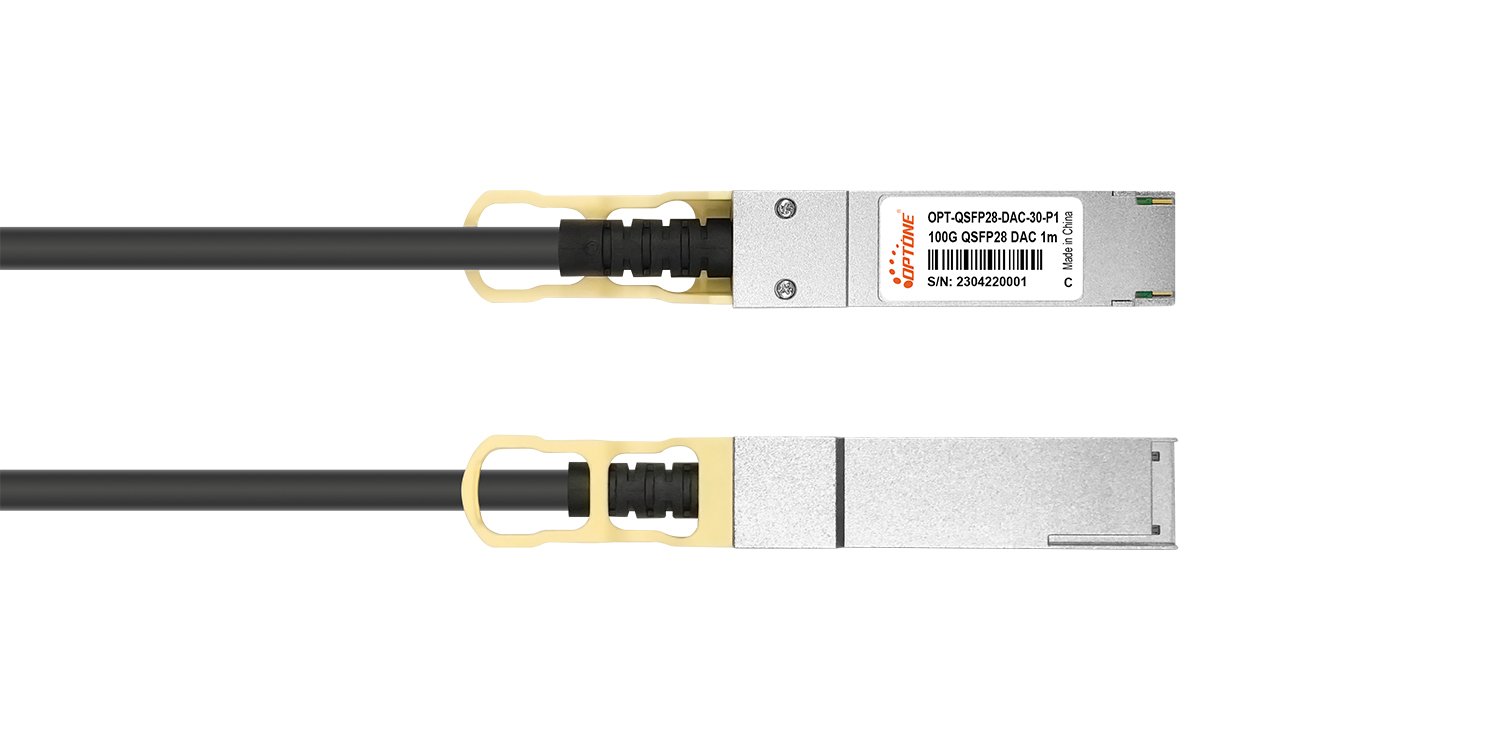
Passive DAC twinax cables remain the standard for intra-rack connections under 5 meters. Because they lack active optical components, they offer the absolute lowest latency and near-zero power consumption. If you are patching servers to a top-of-rack switch, 10G SFP+ direct attach copper or 100G QSFP28 DACs give you a hardwired, highly reliable link that won’t strain the rack’s thermal budget.
The trade-off is bulk. Copper twinax is heavy and has a strict bend radius, making cable management difficult in fully populated 42U racks. You cannot bend them sharply around corners without risking signal degradation.
Active Optical Cables for 2026 AI Compute and GPU Clusters
When you cross the 5-meter mark or need to route hundreds of cables through tight overhead trays, Active Optical Cables take over. Modern AI compute nodes and GPU clusters demand 200G QSFP56 active optical cables and 400G links that maintain signal integrity across rows. AOCs embed the optical transceivers directly into the cable ends, eliminating the need for separate modules and patch cords. They are lighter, thinner, and immune to electromagnetic interference, making them the only practical choice for end-of-row or middle-of-row topologies.
Power Consumption and Latency Trade-Offs: AOC vs. DAC
The decision between these two formats usually comes down to distance, but power and latency are the hidden costs. A passive DAC draws less than 0.1W per port. An AOC draws between 1W and 2.5W depending on the data rate. In a 32-port 100G switch, choosing AOCs over DACs adds up to 80 watts of continuous power draw, plus the associated cooling load.
| Specification | Passive DAC | Active Optical Cable (AOC) |
|---|---|---|
| Max Distance | Up to 5m | Up to 100m |
| 100G AOC vs DAC power consumption | < 0.1W | ~2.0W to 2.5W |
| Latency | Near zero | ~2-3 nanoseconds |
| Cable Weight & Bend | Heavy, rigid | Light, flexible |
| Primary Application | Top-of-Rack (ToR) | End-of-Row (EoR), Spine-Leaf |
Verified OEM Compatibility for Cisco, Arista, and Juniper Platforms
Vendor lock-in forces data centers to overpay for branded cables. OPTONE bypasses this by writing OEM-specific EEPROM code directly to our assemblies. Whether you need a Cisco compatible 40G QSFP+ AOC or a 100G DAC coded for Arista spines and Juniper leaves, the hardware will be recognized natively.
We program and test each end independently. You can order OEM compatible DAC twinax cables with a Cisco-coded QSFP on one end and a Mellanox-coded QSFP on the other, solving cross-vendor integration issues at the physical layer.
In-House Testing Protocols: DDM/DOM and Burn-In Validation
Compatibility claims mean nothing without physical validation. Every cable undergoes live-switch testing before shipping. We verify Digital Diagnostic Monitoring (DDM/DOM) reporting, ensuring your network management tools read the correct temperature, voltage, and optical power levels. Active assemblies go through thermal burn-in cycles to catch early-life transceiver failures before they reach your facility.
400G Breakout Configurations and Custom Length Assemblies
Standard 1-meter, 3-meter, and 5-meter lengths rarely match the exact physical layout of a custom build. Excess cable creates air dams in the rack, while cables stretched too tight risk port damage. We manufacture custom length active optical cables and DACs to your exact specifications, from 1 to 100 meters.
High-density environments also rely heavily on port bifurcation. 400G QSFP-DD breakout cables split a single high-speed switch port into four 100G or eight 50G server connections. This reduces the total number of switches required in the rack and lowers the overall network footprint.
Direct Factory Procurement for US Enterprise Teams
Sourcing interconnects through multi-tier distribution channels adds weeks to lead times and inflates the unit cost. OPTONE operates as a direct manufacturer. US-based telecom operators and enterprise network teams buy straight from our Shenzhen facility. You get factory-direct pricing, custom EEPROM programming, and exact cable lengths without the distributor markup.
Review the technical specifications, compare power draws, and request a quote for your next deployment by browsing our full range of AOC and DAC interconnects.
Need help selecting the right product?
Share your switch platform, link distance and quantity with an OPTONE engineer.
Talk to an Engineer →