
What is an optical transceiver?
An optical transceiver is a self-contained module that converts electrical signals into light and light back into electrical signals. One end plugs into a switch, router, server NIC, or media converter; the other end terminates a fiber optic connector (typically LC duplex for single-pair optics, MPO for parallel optics).
Inside the cage it looks unremarkable — a metal shell with a PCB — but it contains a transmitter (a laser or VCSEL plus driver), a receiver (photo detector plus amplifier), a clock/data-recovery or DSP that cleans up the signal, and a small management controller that reports diagnostics over I²C. Because modules follow MSA (multi-source agreement) standards such as SFF-8431 (SFP+) and the QSFP-DD MSA, ports from different switch vendors accept compatible modules — the plug shape and electrical interface are standardized, not proprietary.
Switch cageelectricaledge (SFP/QSFP)Transceiver PCBLaser / VCSELPhoto detectorDSP / CDRmanagement: DDM (Rx power, temp, bias)Fiber connectorLC duplex / MPO
Inside a pluggable optical transceiver: electrical cage on the left, fiber connector on the right, and the optics plus DSP in between. DDM diagnostics let the switch read each port’s received optical power in dBm.
Hot-swappable by design. Modules insert into a cage on the port panel and are replaced without powering down the switch. That is why one switch model can serve 1G, 10G, 25G, and 100G links — the optics, not the switch, set the media type.
Form factors and speeds
Form factor = physical size and electrical interface. As speeds rose, the industry kept the same small family of shells and added more electrical lanes instead of inventing new plugs for every rate:
| Form factor | Max rate | Electrical lanes | Modulation | Typical use |
| SFP | 1 GbE | 1 | NRZ | Campus, WAN uplinks |
| SFP+ | 10 GbE | 1 | NRZ | ToR, storage, metro |
| SFP28 | 25 GbE | 1 | NRZ | 25G server access |
| QSFP28 | 100 GbE | 4 | NRZ | Data center spine, campus core |
| QSFP56 | 200 GbE | 4 | PAM4 | 100G-per-lane migration |
| QSFP-DD | 400 / 800 GbE | 8 / 16 | PAM4 | Hyperscale, AI clusters |
| OSFP | 400 / 800 GbE | 8 | PAM4 | Switch-optimized 800G |
Two details matter when planning: QSFP-DD is backward compatible with QSFP28/QSFP56 ports (one QSFP-DD cage can host two 50G-PAM4 pairs or a single 100G module via adapters), and OSFP is physically larger with a higher thermal envelope — the trade-off for very high-power modules. 800G in QSFP-DD and OSFP is now shipping in AI and hyperscale fabrics, with 1.6T in OSFP on vendor roadmaps.
How speed scales: lanes and modulation
All transceiver speeds are built from the same formula: total rate = lanes × per-lane rate. Two levers move the total up:
- More lanes. A 100G QSFP28 carries 4 × 25G lanes (4 pairs of fibers, MPO connector). A 400G QSFP-DD carries 8 × 50G lanes; 800G uses 8 × 100G lanes.
- Faster modulation per lane. NRZ (PAM2) sends one bit per symbol, topping out at 25–28G per lane. PAM4 sends two bits per symbol at the same baud rate, which is how the industry jumped from 25G to 50G and 100G per lane without doubling the spectrum.
PAM4 has a price: two bits per symbol halves the noise margin, so PAM4 links depend on forward error correction (FEC) in the switch silicon. When you compare 100G (NRZ) and 200G (PAM4) modules, the FEC budget is part of the system design — check that both ends support the same FEC mode.
This is also why the same form factor can carry different speeds. QSFP28 was defined for 4 × 25G (100G); QSFP56 reused the same shell for 4 × 50G PAM4 (200G). Always match module rate and switch port rate — a 200G module will not fall back to 100G in a 100G port.
Reach classes: SR, LR, ER, ZR
Reach class is the part of the part number that tells you how far the module is rated to go. The ladder is standardized by IEEE 802.3 PHYs and the OIF 400ZR agreement, so the letters mean the same thing across vendors:
- SR (short reach) — 850 nm optics on multimode fiber, tens to a few hundred meters (e.g., 100 m for 100GBASE-SR4 on OM4).
- LR (long reach) — 1.3 μm single-wavelength optics on single-mode fiber, 10 km (e.g., 10GBASE-LR, 100GBASE-LR4).
- ER (extended reach) — 40 km over single-mode fiber (100GBASE-ER4), usually with higher transmit power and a more sensitive receiver.
- ZR (coherent) — the 400G ZR standard from the OIF: a coherent QSFP-DD module that reaches 80 km without amplification, and ZR+ variants that stretch to 120 km and beyond with DWDM amplifiers.
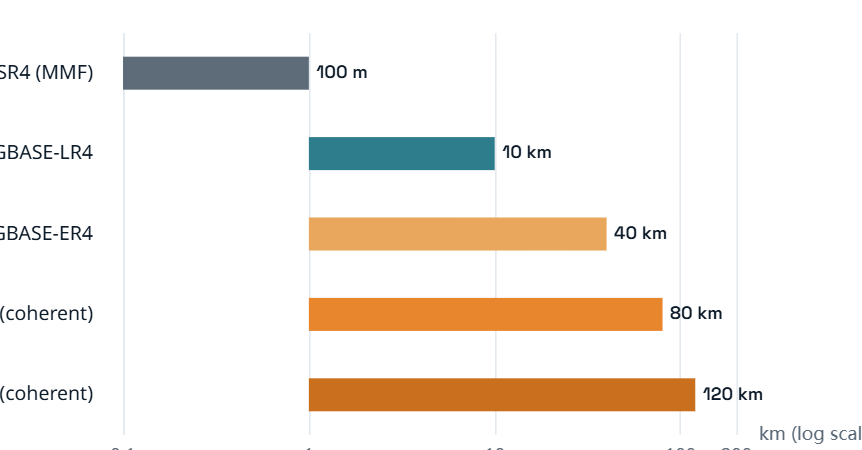
How far one transceiver link reaches (log scale). SR on multimode: 100 m (100GBASE-SR4). LR: 10 km (100GBASE-LR4). ER: 40 km. 400G ZR coherent: 80 km; ZR+: 120 km. Sources: IEEE 802.3 PHY documents, OIF 400ZR, vendor datasheets.
For distances beyond a few kilometers, the fiber must be single-mode and the optics must be rated for the reach — a 10 km LR module will not light a 40 km span, and an 80 km ZR module is unnecessary (and power-hungry) on a 500 m in-building run. Coherent ZR/ZR+ modules add a tunable laser and DSP and are the standard tool for data center interconnect (DCI) over existing DWDM fiber.
Power and heat: the hidden constraint
At 100G and above, power is often the real limit — not optics. A fully loaded 800G switch with 32 modules can draw hundreds of watts from the optics alone, which drives airflow design, port density, and even which form factor you can choose.
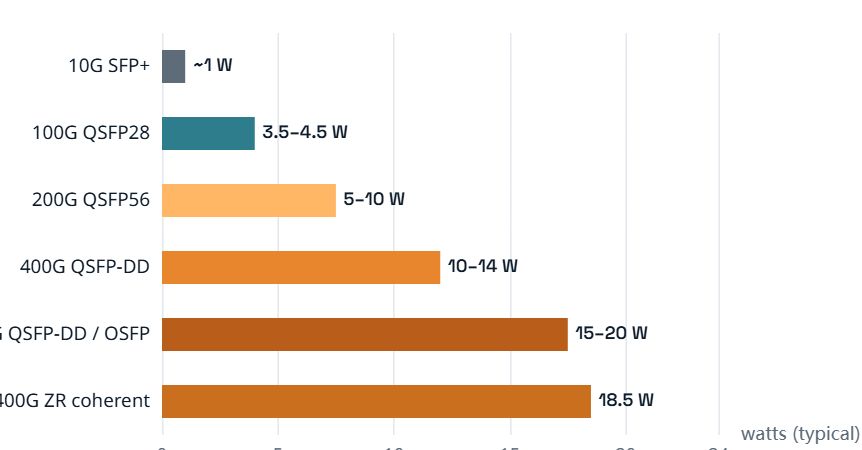
Typical power per module by speed class (bar shows midpoint of vendor-typical ranges; labels show the range). 400G ZR coherent modules sit at the top because of the DSP. Sources: Cisco SFP+ data sheet, NVIDIA transceiver documentation, IPTP Networks, LINK-PP, FS coherent module data sheets.
Power classes are negotiated, not assumed. SFP/SFP+ modules declare a power class (1.0 W to 5.0 W per the SFP MSA) so the host knows whether the port can support them. Before buying high-power QSFP-DD or OSFP modules, check the switch’s per-port power budget and airflow direction — an 800G module in a port rated for 12 W will not run.
Thermal design is why 800G is dominated by OSFP and QSFP-DD rather than older shells: OSFP has a larger body and a dedicated heat sink surface, and QSFP-DD spreads the same 800G across 16 electrical lanes to keep signal integrity manageable. In dense AI racks, optics cooling is now a first-class design constraint alongside the GPUs.
Copper, DAC, AOC, or optics?
Optical transceivers are not always the right answer. Inside a rack, copper beats optics on cost and power:
| Media | Typical reach | Power per end | Use when |
| Passive DAC (copper twinax) | ≤7 m (100G), ≤3 m (400G) | ~0.1 W | Top-of-rack, same-rack links; lowest cost and latency |
| Active copper / AEC | ~10 m | 1–3 W | Cross-rack copper where passive DAC is too short |
| AOC (active optical cable) | 30–100 m | ~2 W+ per end | Between racks without patch panels; fixed length, no field-replaceable optics |
| Pluggable optics (SR/LR/ER/ZR) | 100 m to 120 km+ | 1–22.5 W | Structured cabling, campus, metro, DCI; swappable and re-rateable |
The decision rule: same rack → DAC; adjacent racks → AOC or SR4 optics; anything beyond 100 m → pluggable optics on structured fiber. Pluggable optics earn their cost when the fiber plant is permanent — you can re-rate a 100G port to 400G later by swapping the module, not the cable.
What to check before buying
- Match the form factor to the port. A QSFP28 port takes QSFP modules; an SFP+ port takes SFP/SFP+ modules. QSFP-DD ports accept QSFP-DD and (via adapter) QSFP28/QSFP56, but an OSFP port is OSFP-only.
- Match speed on both ends. Module rate, switch port rate, and the far-end module must agree — 25G, 100G, 200G, 400G. PAM4 modules will not interop with NRZ modules at the same nominal speed.
- Choose reach class by fiber, not by wish. MMF (OM3/OM4, 850 nm) → SR. SMF beyond 300 m → LR (10 km), ER (40 km), or ZR (80 km+). Never put an SR module on a 2 km single-mode run.
- Check the connector. LC duplex for 1–10 km single-pair optics; MPO-12 (MTP) for SR4/SR8 parallel optics. A module and cable with different connectors will not mate without a breakout.
- Verify power class and airflow. Compare the module’s max power (1 W SFP+ to 22.5 W coherent) against the switch’s per-port budget, and match airflow direction (front-to-back vs back-to-front).
- Confirm DDM and management. Digital diagnostics (SFF-8472 on SFP+, DDM on QSFP) let you read Rx power, temperature, and bias — worth having for monitoring and fault finding.
- Check vendor compatibility lists. MSA standards make most modules interoperable, but some switches enforce vendor codes. Ask for the switch vendor’s compatibility list or a tested third-party module.
- Plan the upgrade path. If 100G will become 400G in the same racks, choose QSFP-DD or OSFP switches now, and keep the fiber plant at OM4/SMF — optics change, fiber is harder to change.
Common mistakes to avoid
- Buying an SR module for a long single-mode run — the most common optical failure, and it never announces itself until the link is down.
- Mixing NRZ and PAM4 at the same port speed, then wondering why the link will not come up.
- Ignoring the power budget and installing high-power 400G/800G modules in ports rated for less.
- Using MPO modules on LC cables (or vice versa) without a breakout — connectors are not adapters.
- Buying counterfeit or uncertified modules that save 30% and fail in the field; check the vendor’s compatibility list before purchase.
- Forgetting that optical connectors need cleaning — dust on the ferrule is the #1 cause of intermittent high-error links.
Frequently asked questions
What is the difference between SFP, SFP+ and QSFP?
SFP, SFP+ and SFP28 are single-lane modules for 1G, 10G and 25G. QSFP is the four-lane family: QSFP28 (100G, 4 × 25G NRZ), QSFP56 (200G, 4 × 50G PAM4), and QSFP-DD (400G/800G, 8+ lanes). The physical plugs differ — an SFP module never fits a QSFP port.
How far can an optical transceiver transmit?
It depends on the reach class and fiber. SR on multimode fiber reaches 100–300 m; LR on single-mode reaches 10 km; ER reaches 40 km; 400G ZR coherent reaches 80 km unamplified, and ZR+ up to 120 km (and further with DWDM amplification).
What does PAM4 mean and why does it matter?
PAM4 is a modulation format that sends two bits per symbol instead of one (NRZ), doubling the data rate per lane. It is how 50G and 100G per-lane rates are achieved, and it requires forward error correction (FEC) in the host silicon because the signal margins are tighter.
What is DDM in an optical transceiver?
DDM (Digital Diagnostics Monitoring) is a management interface that reports received optical power (dBm), module temperature, supply voltage, and laser bias current. It lets the switch or NMS warn you before a link degrades — most SFP+/SFP28/QSFP modules include it (SFF-8472 for SFP+).
400G ZR vs ZR+ — what is the difference?
400G ZR is the OIF-standard coherent module for 80 km links, interoperable between vendors. ZR+ (and OpenZR+) adds tunable DWDM modes and higher transmit power for 120 km and amplified multi-span links, at the cost of more power and typically 1–2 dB less interoperability margin.
Can I use a third-party optical module in a Cisco or Arista switch?
Usually yes — MSA form factors are standardized, so a compatible module will mechanically and electrically fit. Some vendors enforce a compatibility check on the module’s management EEPROM. The safe path is to buy modules listed on the switch vendor’s compatibility matrix.
SR vs LR: which should I choose?
Choose SR when both ends are within ~100–300 m on multimode fiber (same building, same floor). Choose LR (10 km) when the link leaves the building on single-mode fiber. LR modules are usually slightly more expensive but work on any SMF run up to 10 km.
Need help selecting the right product?
Share your switch platform, link distance and quantity with an OPTONE engineer.
Talk to an Engineer →