
A module that fits the cage can still fail the link. Host coding, lane count, fiber type, connector polish, optical budget and operating temperature all need to agree before a switch port will stay up. That is why serious buyers assess an optical transceiver manufacturer in China on compatibility evidence, not on a product photo or a low unit price.
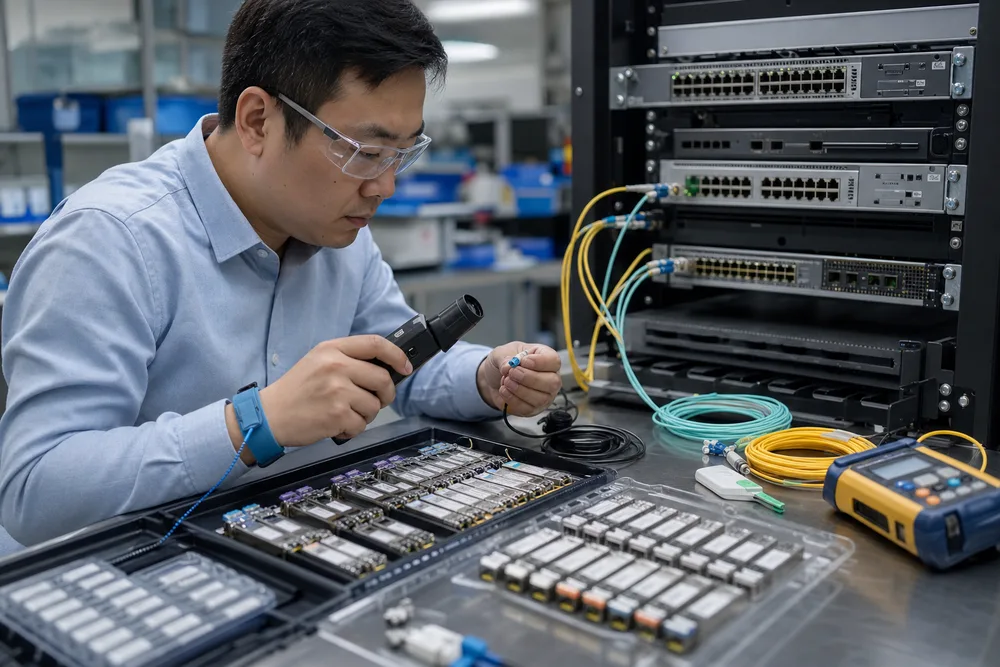
Key Takeaways for Sourcing Optical Transceivers and Connectivity Hardware in China
- Match the host port’s supported speed, form factor, interface standard and vendor-compatibility policy before ordering.
- Choose optics around the installed fiber plant and required reach; SR, LR, ER and ZR labels are not interchangeable.
- Request part numbers, coding requirements, connector type, temperature class and test expectations in every RFQ.
- Use DAC for short, controlled rack links; use AOC where a lighter active cable is useful; specify optical modules for structured fiber runs.
- For China deployments, confirm applicable GB requirements and the certifications required by your project or customer before shipment.
China offers a broad supply base, from standard MSA-form-factor modules to complete edge connectivity packages with media converters, DIN-rail hardware, PoE switches and fiber Ethernet switches. The useful question is not simply who can supply the category. It is who can identify the exact interface boundary between your active equipment and your cabling plant.
OPTONE is a Shenzhen-based optical connectivity manufacturer founded in 2003. Its range spans MSA-compliant transceivers from 1G SFP through 800G OSFP, alongside AOC/DAC assemblies, media converters and Ethernet switches. For buyers, that breadth matters when an access network or data-room build mixes copper handoffs, fiber uplinks and different environmental classes.
Buyer FAQ: How Do I Confirm Compatibility, Choose the Right Form Factor, and Decide Between AOC and DAC?
How can I verify that an optical transceiver will work with my switch, router, or firewall?
Start with the exact host make, model, port type and network operating-system version. Then provide the existing vendor module part number if one is installed, plus the intended speed, fiber type and link application. A compatible optic must satisfy more than the physical cage: its EEPROM identification and vendor coding need to be accepted by the host, while its optical interface must match the far end. Ask for a compatibility review and, for sensitive platforms, sample validation in the actual hardware. Do not assume a module that works in one vendor’s switch will be accepted in another vendor’s firewall or router.
How should I select SFP, SFP+, SFP28, QSFP28, QSFP-DD, or OSFP for my network port?
Select the form factor stated for the port first. SFP commonly serves 1G applications; SFP+ is associated with 10G; SFP28 with 25G; and QSFP28 is widely used for 100G interfaces. QSFP-DD and OSFP address higher-density, higher-speed designs, including current 400G and 800G ecosystems. Physical fit is only step one. Check whether the port supports breakout operation, which electrical lanes it presents, and which optical standards the equipment supplier permits. A QSFP port is not a generic upgrade path just because its connector shape resembles another QSFP family.
AOC and DAC decisions are usually made at the rack level. Passive or active direct-attach copper is practical for short equipment-to-equipment runs where cable routing and bend space are controlled. An active optical cable is lighter and avoids separate pluggable optics, but it is a fixed assembly: if one end is damaged or the length changes, you replace the cable. For patch-panelled routes and cross-room links, separate transceivers and fiber cabling are usually the serviceable choice.
Optical Transceiver Selection Table: Form Factor, Fiber Type, Reach, Connector and Deployment Environment
The table below is a screening tool, not a substitute for a port datasheet. Reach classes are determined by the applicable optical interface standard, fiber grade and link conditions. In procurement, record the required reach rather than writing “long distance”; that phrase has caused more than a few wrong-module deliveries.
| Form factor / connectivity | Typical fiber or cable | Reach decision | Connector / interface | Deployment check |
|---|---|---|---|---|
| SFP, SFP+, SFP28 | Multimode or single-mode fiber; some copper SFP options | Match the specified optical reach to the installed plant | Often duplex LC for fiber; RJ45 for copper variants | Access, enterprise and telecom port compatibility |
| QSFP+, QSFP28, QSFP56 | Parallel or duplex fiber, depending on interface | Confirm lane arrangement and breakout need | Interface-dependent optical connector | Aggregation and data-center links |
| QSFP-DD, OSFP | Usually single-mode or multimode fiber by standard | Validate host thermal and port-standard support | Interface-dependent optical connector | High-density 400G/800G equipment |
| AOC / DAC | Integrated optical or copper cable assembly | Order the finished assembly length required | Fixed transceiver ends | Short rack and adjacent-cabinet runs |
How SR, LR, ER and ZR Options Relate to Multimode Fiber, Single-Mode Fiber and Link Requirements
SR is generally selected for short-reach multimode-fiber applications. LR, ER and ZR options are generally associated with longer single-mode-fiber links, but the label alone is not a purchase specification. Check the exact Ethernet or telecom interface, the fiber grade already installed, the number of connections and any attenuation from splitters, patch panels or splices. A long-reach optic on a very short path can also require engineering attention; excessive received power is a real concern, not a theoretical one. Obtain the required standard and target path characteristics from the network designer before choosing the reach class.
When to Specify BiDi, CWDM, DWDM, Copper SFP, AOC or DAC Connectivity
Specify BiDi when you need bidirectional transmission over one fiber and can control the matched wavelength pairing at both ends. CWDM and DWDM are for wavelength-multiplexed designs, where channel planning, passive components and optical power management must be treated as one system. Copper SFP products can help bridge an available SFP port to an RJ45 Ethernet run, but host support, cable category, distance and heat in a crowded switch must be checked. For an established copper link, a copper SFP is not automatically cheaper once support risk and power draw are considered.
Step-by-Step RFQ Checklist for Optical Modules, Media Converters, Cables and Fiber Ethernet Switches
An RFQ that says “100G module, compatible with Cisco” leaves too much room for error. The supplier needs enough information to quote the right coded module, not merely a similarly shaped one. This applies equally to fiber media converters, where copper interface, fiber connector, managed features and power arrangement can differ, and to industrial switches, where mounting and temperature requirements often decide the build.
- Identify the active equipment. State manufacturer, exact model, port type, software version where relevant, and existing approved optic part number.
- Define the link. Give speed, protocol or application, endpoint equipment, installed fiber type, connector arrangement and required route reach.
- Specify the optical approach. State SR/LR/other required interface, BiDi wavelength pair, or CWDM/DWDM channel plan where applicable.
- Set the environment. Identify commercial or industrial temperature expectations, indoor/outdoor enclosure conditions, power input needs and DIN-rail requirements for industrial hardware.
- State compatibility and evidence needs. Request OEM coding, DDM/DOM availability, test records required by your QA process, samples, labeling and packaging requirements.
- Confirm commercial details. Include quantities, staged delivery, destination, required certifications, warranty expectations and whether OEM/ODM work is requested.
For switches, add port counts, uplink requirements, PoE needs, management expectations and redundancy features required by the design. For cables, identify end types, length, polarity or breakout mapping, and equipment at both ends. Those details prevent the common site failure where every component is technically correct but the assembly cannot be connected as installed.
OPTONE’s Shenzhen Manufacturing Approach: MSA-Compatible Modules, OEM Coding and Test Evidence
OPTONE supplies MSA-compliant optical transceivers across SFP, SFP+, SFP28, QSFP+, QSFP28, QSFP56, QSFP-DD, OSFP and XFP families, as well as BiDi, CWDM, DWDM and copper SFP products. MSA compliance addresses the mechanical and electrical conventions that allow modules and host cages to interoperate. It does not override a network-equipment vendor’s own coding checks or feature restrictions. Buyers should keep that distinction clear.
OPTONE OEM Coding and Test Evidence process is the useful procurement concept here: OEM coding means programming a module’s identification information for the nominated host compatibility requirement, while test evidence concerns the measurements and records requested to support acceptance. The company identifies DDM/DOM and TX/RX power testing among its relevant capabilities. DDM/DOM exposes operating diagnostics such as optical transmit and receive power where supported, helping your operations team investigate a marginal link after installation rather than guessing from a port-down alarm.
Ask exactly what evidence will accompany your order and at what level: by shipment, lot or serialised unit. Also ask whether your named platform can be reviewed before volume production. You can review the available OPTONE optical transceiver and fiber connectivity range before preparing that compatibility list.
China Deployment Considerations: DDM/DOM, Commercial and Industrial Temperature Requirements, GB Standards and Applicable Certifications
DDM/DOM is valuable only if you use it. Build monitoring thresholds and escalation practice around the diagnostic values your host exposes, then retain a baseline from commissioning. Falling receive power may point to contamination, a damaged patch cord, connector loss or fiber degradation. It does not, by itself, prove the transceiver is defective. Clean and inspect the optical path before replacing good hardware.
Temperature class is another routinely overlooked line item. Commercial-grade equipment may be appropriate in conditioned data rooms and offices. Industrial deployments can require equipment designed for the actual temperature range, vibration, dust, power conditions and mounting arrangement at the site. A DIN-rail industrial switch mounted in a roadside cabinet has different constraints from a rack switch in a climate-controlled equipment room. Do not substitute one for the other because the port list matches.
For projects in China, establish which GB standards, market-access rules and customer-specific certifications apply to the finished system before you release a purchase order. The requirements can depend on the product type, application, installation location and project owner. A supplier can provide relevant product information, but the buyer or system integrator should confirm the acceptance basis with the project authority, local compliance team or tender documents. This is especially relevant where PoE equipment, telecom networks or public-sector infrastructure are involved.
Request Compatibility Review, Samples or a China Project Quotation from OPTONE at https://fibertransceiver.com/
Send OPTONE your equipment list, port maps, existing module labels, fiber details and destination requirements. For a first deployment, request samples for host validation before committing the project quantity. For mixed builds, include media converters, AOC/DAC cables and managed, unmanaged, PoE or industrial fiber switch requirements in the same package so interface ownership is clear from the start.
Send a complete compatibility brief
Provide host models, port types, fiber plant details, coding needs and environmental requirements for a focused OPTONE review, sample request or China project quotation.
Need help selecting the right product?
Share your switch platform, link distance and quantity with an OPTONE engineer.
Talk to an Engineer →