
China fiber media converters can give U.S. network buyers a practical combination of Ethernet-to-fiber product choice, deployment-specific formats, and direct access to a manufacturer. The benefit is not the country of origin by itself. It comes from selecting a converter that matches the actual copper port, fiber plant, power arrangement, environment, and management requirement—and confirming those details before a purchase order is released.
For many projects, a fiber media converter is the least disruptive way to extend an existing Ethernet connection beyond the limits or conditions that suit copper. It lets you retain an RJ45 device at one or both ends while carrying the interconnecting link over fiber. That can be useful in campuses, security systems, telecom cabinets, enterprise facilities, and distributed network sites. A bad match, however, can leave you with a link that will not establish, a powered device that will not start, or optics that do not correspond at opposite ends.
The Direct Answer: Value Comes From the Right Conversion, Product Fit, and Verification
The useful value of a China fiber media converter is choice backed by disciplined procurement. A manufacturer such as OPTONE offers commercial, industrial, PoE, WDM, SFP-based, and 10G Ethernet-to-fiber converter categories, along with standalone units and chassis systems. That breadth can help you source different link types through one supplier instead of forcing every site into a single converter design.
Start with the problem, not a catalog label. Is the remote endpoint an existing copper switch, IP camera, wireless access point, controller, or server interface? Is the installed fiber single-mode or multimode? Does a field cabinet need DIN rail mounting? Does the endpoint draw power through Ethernet? The answers narrow the selection quickly.
Buyers sometimes focus on the word “gigabit” and miss the rest of the path. Link speed matters, but so do the RJ45 interface behavior, the optical interface, connector style, fiber type, available power, and conditions at the remote location. A converter that looks right in a line-item description may still be wrong for the installed cable or powered endpoint.
Why Ethernet-to-Fiber Conversion Is Used in Network Extensions
An Ethernet-to-fiber media converter changes the physical medium used for an Ethernet link: copper Ethernet on the RJ45/TX side and optical transmission on the FX or SFP side. It is generally used to preserve an Ethernet connection while moving the longer or more exposed portion of that connection onto fiber.
Keep Existing RJ45 Ethernet Devices While Moving the Link to Fiber
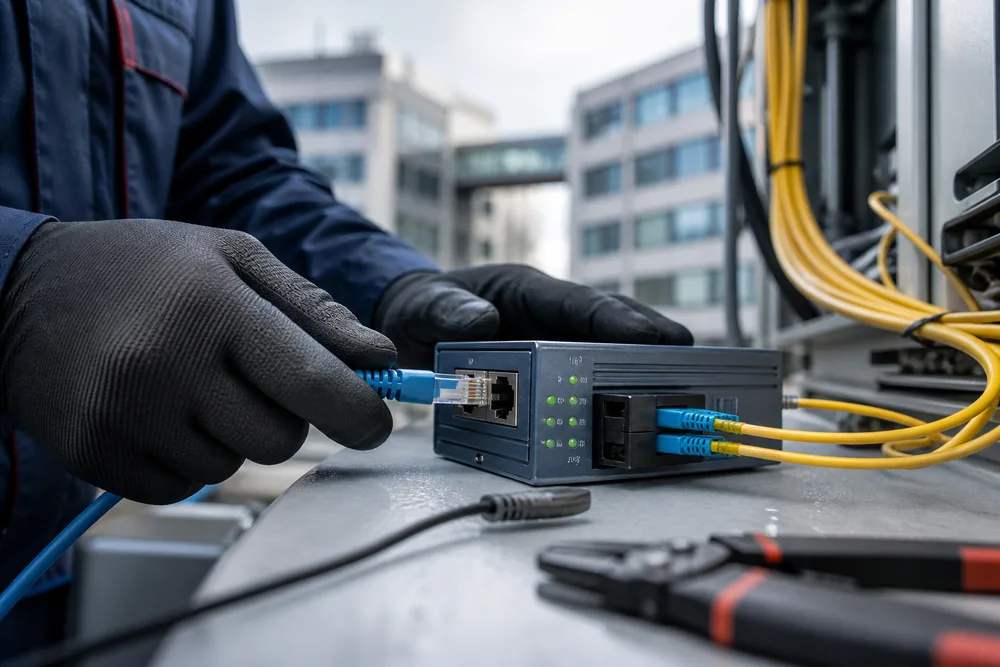
Many installed devices present only an RJ45 Ethernet port. Replacing every camera, access point, industrial controller, or edge switch just because fiber is needed between buildings is rarely the first choice. A fiber media converter with an RJ45 port can sit beside the copper device and connect it to the fiber run. A corresponding converter, switch port, or compatible optical interface terminates the other end.
This approach keeps the endpoint interface familiar. The converter is not a substitute for network design, though. It does not correct a speed mismatch, solve an incompatible duplex setting, or make a non-PoE device become PoE-capable. Treat it as a physical-media transition in a link that must still be correctly matched end to end.
Use Fiber Where Copper Distance, Interference, or Site Separation Creates Constraints
Fiber is often chosen where a copper run is no longer appropriate for the route. The reason may be distance, electrical interference near machinery, a connection between separate buildings, or the need to place the network link in an electrically nonconductive medium. The specific fiber type and optical interface must fit the route already installed or planned.
That last point is where projects get expensive. A single-mode fiber converter is not interchangeable with a multimode design. Nor can an SC connector be assumed to mate with an LC patching system without the correct patching approach. Identify the cable plant before choosing the hardware.
Choose the Converter Format Around the Deployment Rather Than the Product Label
Format affects installation, spares, maintenance, and how easily a network team can grow the system. The right choice is usually obvious once you know whether the project is one isolated link, a group of links in one rack, or a remote installation with a defined fiber architecture.
Standalone, SFP-Based, and WDM Options for Individual Links
Standalone converters suit individual links where a compact device can be placed near the endpoint or inside a local enclosure. They are straightforward to replace and practical for distributed sites, provided power and mounting have been planned.
An SFP fiber media converter uses an SFP optical interface rather than fixing every optical parameter in the converter body. This can be useful where your design needs an optical module selected around the fiber type, connector, or intended link characteristics. It also creates another compatibility checkpoint: confirm the SFP is supported by the converter and that the module at the far end is optically compatible.
WDM converter options use wavelength-division multiplexing to carry transmission directions over a fiber arrangement appropriate to that design. They can be relevant where fiber availability is constrained. They must be bought as a matched link, not as two visually similar units. Ask the supplier to state the required pairing and confirm it against the route documentation.
Explore available fiber media converter configurations only after documenting the endpoints and fiber plant. Browsing products first tends to produce avoidable substitutions later.
Managed Chassis Options for Centralized Multi-Link Deployments
A managed media converter chassis makes more sense when numerous converter links terminate in one central equipment room or rack. OPTONE lists 14-slot, 16-slot, and managed chassis options. Centralized housing can reduce scattered power adapters and make a bank of links easier to organize than a shelf full of individual standalone devices.
Management has value only if someone needs the visibility or control it provides. For a single uncomplicated extension, an unmanaged converter may be the more appropriate choice. For a collection of remote links that must be monitored from a central point, ask what the chassis and installed modules can report or control, how they are accessed, and what happens to service visibility if chassis power is lost.
Match PoE, Industrial Design, and Link Capacity to the Remote Site
Remote sites expose the difference between a converter that merely passes data and one that fits the installation. Power delivery, mounting, power-input type, environmental conditions, and required Ethernet capacity should be decided as a group. Buying them as separate assumptions is a common cause of site rework.
PoE and PoE+ Conversion for Cameras, Access Points, and Other Powered Devices
A PoE fiber media converter can combine fiber uplink conversion with Ethernet power delivery to a compatible powered device. That can simplify a remote camera or access-point installation by reducing the need for a separate local power arrangement at the endpoint. OPTONE’s range includes PoE and PoE+ products, but the presence of those labels does not answer every power question.
Confirm which RJ45 port provides power, which device role the converter supports, and whether the unit’s available PoE output suits the endpoint’s stated requirement. Also verify the converter’s own power input and the planned power source. A camera may establish a data link while behaving unpredictably under load if its power requirement has been treated as an afterthought.
Do not assume a PoE converter can power anything plugged into its copper port. The product documentation needs to identify the intended powered-device behavior. If you are feeding a downstream switch, multiple cameras, or another device that powers equipment, review the whole power chain rather than just the first port.
Industrial and DIN Rail Media Converters for Cabinet and Field Installations
An industrial fiber media converter is intended for installations where cabinet mounting and site conditions call for a different physical design than an office or rack environment. DIN rail mounting is particularly relevant in control cabinets, utility enclosures, factory panels, and other locations where equipment must be secured alongside other rail-mounted hardware.
“Industrial” should never be treated as a complete environmental specification. Check the documented operating conditions, enclosure details, power-input requirements, grounding instructions, mounting clearance, and any relevant approvals for your site. A DIN rail fiber media converter may fit the rail perfectly and still be unsuitable if the cabinet temperature, power source, or maintenance access has not been checked.
Capacity belongs in this review as well. OPTONE offers products that include 10G Ethernet-to-fiber conversion, but 10G is useful only where the connected copper equipment, switching path, optical interface, and traffic requirement support it. Paying for more bandwidth than the endpoint can use does not improve a constrained link.
What Factory-Direct Sourcing Can Add to a Media Converter Project
Factory-direct sourcing can give you a clearer path to discuss product families, interface combinations, production availability, documentation, and delivery expectations with the organization making the equipment. For U.S. buyers managing mixed deployments, that can be valuable when the order includes commercial converters for indoor links, industrial units for cabinets, and chassis-based equipment at a central site.
OPTONE identifies itself as a Shenzhen manufacturer serving telecom operators, data center operators, ISPs, enterprise network teams, and network engineers in multiple countries. That supplier profile is relevant because those buyers often need options across optical transceivers, fiber converters, AOC/DAC cables, and fiber Ethernet switches. It does not remove the buyer’s responsibility to qualify the exact product.
Evaluate Product Range, Compatibility Positioning, Testing, and ISO 9001 Quality Controls
Ask targeted questions. Does the supplier clearly position the converter for the required RJ45 speed and fiber interface? Can it provide the relevant product documentation, installation guidance, and test information for the ordered configuration? What inspection or functional-test records are available for the shipment? A broad product range is useful only if the supplier can identify the exact selection and its compatible counterpart.
If ISO 9001 quality controls are a purchasing requirement, request current certification documentation and confirm what organization and scope it covers. Do not infer certification from a website category, a factory location, or a product photo. The same rule applies to any regulatory, environmental, or customer-specific documentation your procurement process requires.
Direct discussion is also the right place to clarify packing, labeling, minimum order conditions, lead time, warranty process, technical support, and Incoterms or other delivery terms. Those are commercial details, but they affect deployment just as surely as connector choice does. You can begin that conversation with OPTONE’s fiber networking team while keeping the final selection tied to documented requirements.
What a China-Made Media Converter Does Not Guarantee on Its Own
A China-made converter does not automatically guarantee interoperability, long-term suitability, compliance for a specific installation, or the lowest total project cost. Those outcomes depend on the exact model, the installed cable plant, the endpoints, the power architecture, acceptance testing, shipping terms, and the supplier’s documented support process.
It also does not turn fiber into a cure for every network fault. A converter cannot repair damaged fiber, incorrect polarity, contaminated connector end faces, an overloaded uplink, or a switch configuration problem. If a link fails after installation, the fault may be in the fiber path, module pairing, copper patch lead, power source, or connected equipment—not necessarily in the converter.
Price alone is a weak comparison point. Two units can both be described as Ethernet-to-fiber converters while differing in speed support, fiber interface, PoE role, management capability, mounting format, power input, and supplied accessories. Compare the complete ordered configuration and the evidence behind it.
Verify These Technical Details Before Ordering
Use the following checks as an order-release list. They are short on purpose: each item corresponds to a failure that is much cheaper to catch before equipment ships than during an on-site install.
Confirm RJ45 Speed, Fiber Type, Connector, Optical Interface, and End-to-End Link Matching
- Identify the required RJ45 Ethernet speed at each endpoint and verify that the converter supports the intended connection behavior.
- State whether the installed or planned fiber is single-mode or multimode. Do not leave this as an assumption.
- Confirm the connector arrangement, such as SC, LC, or ST, including what is present on the patch panel and what patch cords are required.
- For SFP-based equipment, identify the exact optical interface needed and obtain compatibility confirmation for the converter and the far-end interface.
- For WDM links, confirm the required matched pair and the fiber arrangement before ordering either end.
- Document what will terminate both sides of the link: converter-to-converter, converter-to-switch optical port, or another supported combination.
Confirm Power Input, PoE Requirements, Environment, Management Needs, Support, and Delivery Terms
- Verify the available local power source, the converter’s required power input, and whether the correct power accessories are included.
- For PoE or PoE+ deployments, confirm the powered endpoint, port role, and power requirement across the complete chain.
- Review mounting, cabinet space, DIN rail needs, operating conditions, and site-specific installation requirements.
- Decide if unmanaged operation is sufficient or if centralized monitoring through a managed media converter chassis is necessary.
- Request product documentation, test or inspection information appropriate to the order, warranty handling details, and technical-support contacts.
- Agree on quantity, labeling, packing, lead time, shipping method, import responsibilities, and delivery terms before issuing the order.
If those answers are documented, you are evaluating a fiber media converter as a working link component rather than a generic commodity. That is the standard that matters most for a U.S. network project.
Need help selecting the right product?
Share your switch platform, link distance and quantity with an OPTONE engineer.
Talk to an Engineer →