
When you deploy multiple 4K IP cameras on a single unmanaged network switch, latency spikes are almost guaranteed. Standard unmanaged switches treat every broadcast packet identically, flooding all ports and chewing through available bandwidth. The video stutters. Frames drop. You lose the exact three seconds of high-resolution footage you actually needed to see.
The OPTONE 8*10/100/1000M TX (OPT-2008) is built to stop this specific failure mode. It functions as a plug and play gigabit switch for ip cameras that brings two critical features to the network edge: hardware-level VLAN isolation and 10K jumbo frame support. You get the fast deployment of an unmanaged switch combined with the traffic control normally reserved for expensive, configured enterprise gear.
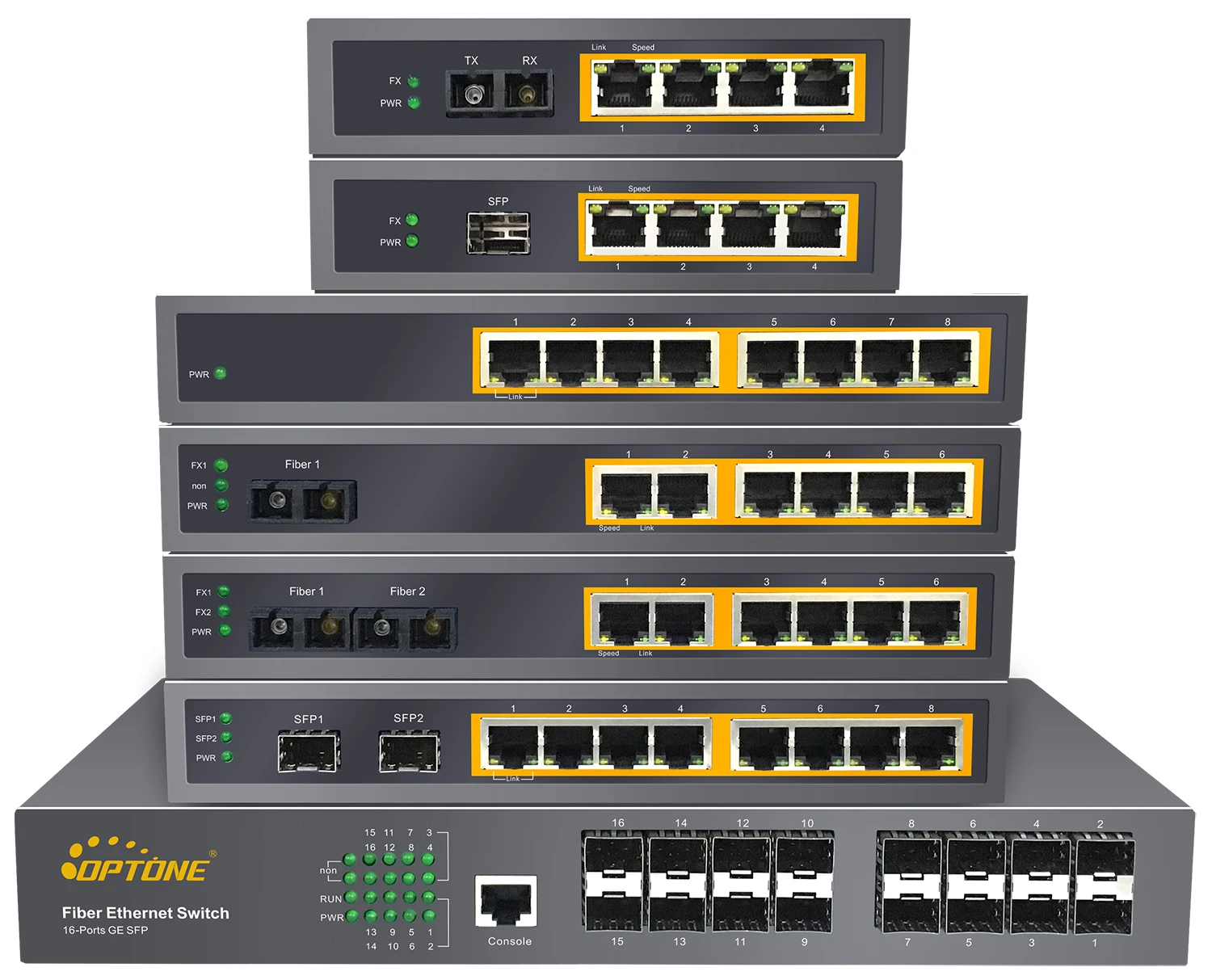
Resolving Broadcast Storms and Video Latency in Camera Networks
Surveillance networks fail differently than standard office networks. A typical office sends bursty, lightweight traffic—web pages, emails, small database queries. IP cameras push a continuous, heavy UDP stream. When multiple cameras share a standard unmanaged 8-port gigabit ethernet switch, broadcast traffic from one connected device hits every other port.
This creates a broadcast storm. The switch CPU works overtime just figuring out where packets belong, and video packets sit in the queue. The result on your NVR screen is tearing, freezing, or complete signal loss.
You could fix this by installing a fully managed switch, but that introduces configuration overhead. It requires trained field technicians to set up subnets, and it breaks the budget for small 4-to-8 camera edge nodes. The better, more scalable fix is an unmanaged switch engineered specifically for continuous high-bandwidth video. By installing the OPTONE OPT-2008, you bypass the configuration phase entirely while protecting the network from broadcast degradation.
How Hardware VLAN Isolation and Jumbo Frames Protect Video Streams
Marketing spec sheets often list “gigabit speed” as if bandwidth alone solves network congestion. It doesn’t. Raw speed is just pipe diameter. Traffic management dictates whether your video feed actually arrives intact.
Physical Port Isolation for Edge Zero Trust Architectures
Standard unmanaged switches allow all connected devices to communicate directly with one another. In an IP surveillance setup, your cameras have no reason to talk to each other. They only need to communicate with the NVR or the uplink port.
The OPT-2008 includes a physical hardware toggle for VLAN isolation. When a field tech flips this physical dip switch, ports 1 through 7 are logically separated. They cannot exchange data with each other; they can only forward traffic to port 8, which serves as the uplink.
This physically isolates broadcast traffic. If a malfunctioning camera, a damaged cable, or a compromised edge device starts flooding the network with broadcast packets, the storm dies at the port. The rest of the cameras continue streaming without interruption. This provides a baseline level of zero-trust security right at the edge, without requiring a network engineer to log into a web interface and configure 802.1Q VLAN tags.
Processing High-Definition Feeds with Marvell ICs and 2Mbit Buffers
Modern H.265 cameras generate massive packets, especially when motion triggers a sudden bitrate spike and forces the camera to send a large keyframe (I-frame). If a switch cannot process large packets in a single cycle, it fragments them into smaller pieces. Fragmentation causes severe CPU drag and introduces latency.
To prevent this, the OPT-2008 is built around a US-designed Marvell integrated circuit (IC). The Marvell IC provides the non-blocking switching capacity required to handle line-rate traffic across all eight ports simultaneously.
More importantly, this smb gigabit ethernet switch marvell ic architecture supports up to 10K jumbo frames. A standard Ethernet frame maxes out at 1,518 bytes. Jumbo frames allow the switch to forward packets up to 10,000 bytes without fragmentation. When paired with the switch’s internal packet buffer, this hardware clears the video queue faster, preventing frame drops during unpredictable 4K and 8K motion events.
Matching the Switch to SMB Office and Surveillance Deployments
Not every deployment needs a 48-port core switch. Many fiber Ethernet switches are over-specced for small edge deployments, driving up power consumption and unit costs. The OPT-2008 is built for small optical Ethernet networks with specific operational needs: localized retail surveillance, parking lot camera clusters, and remote SMB office floors.
In these edge scenarios, physical space is tight and technical support is often hundreds of miles away. You need equipment that powers on and routes traffic immediately. Factory-direct pricing allows ISPs and surveillance integrators to standardize on a single, reliable desktop gigabit switch for ip surveillance without inflating project bids. You achieve predictable, repeatable performance across hundreds of small-site installations because the hardware behaves identically every time you plug it in.
Evaluating Hardware Reliability: Metal Enclosures and Thermal Tolerance
Consumer-grade plastic switches overheat when pushed to maximum throughput. Video streaming pushes switches to that maximum 24 hours a day. Heat degrades the internal silicon, causing intermittent packet loss and random reboots long before the switch actually dies. It is a notoriously difficult failure mode to troubleshoot, as techs will often blame the camera or the cabling first.
You avoid thermal throttling by relying on a desktop 10/100/1000m switch metal housing. The OPTONE OPT-2008 uses its rugged metal enclosure as a passive heat sink. It requires no internal fans, eliminating a primary mechanical point of failure while keeping the unit completely silent.
This fanless thermal design extends the hardware’s lifespan. Whether you mount it in a dusty warehouse, a non-climate-controlled telecom closet, or tucked away under a retail counter, the internal components remain within their safe operating temperatures.
For edge surveillance and high-bandwidth SMB networks, throwing more bandwidth at a broadcast problem is a waste of money. You need traffic isolation and frame handling built directly into the silicon. If you require plug-and-play simplicity combined with enterprise-grade packet processing, the OPTONE 8*10/100/1000M TX (OPT-2008) delivers the Marvell architecture, VLAN isolation, and metal-clad durability required to keep your IP cameras online and your video feeds intact.
Need help selecting the right product?
Share your switch platform, link distance and quantity with an OPTONE engineer.
Talk to an Engineer →