
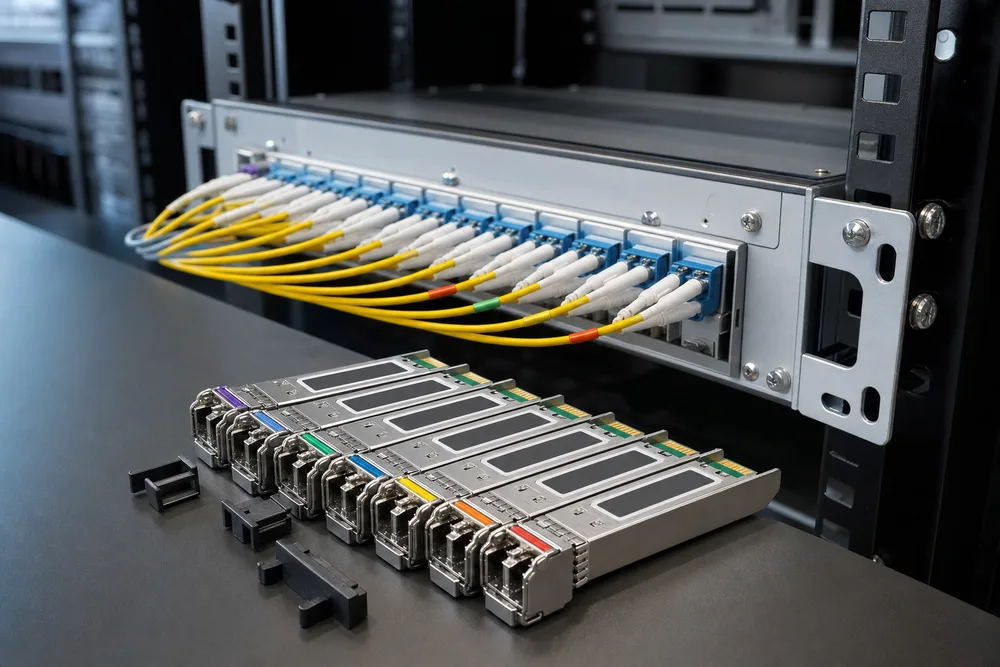
Key Takeaways for China-Based CWDM SFP Buyers
- Confirm the service rate, CWDM wavelength, fiber route and mux/demux port before asking for a price.
- OPTONE’s 155M–2.67G CWDM SFP series is a hot-pluggable, multi-rate SFP family for single-mode fiber with duplex LC interfaces.
- The series covers 18 CWDM wavelengths from 1270nm to 1610nm; reach is variant-specific, with 80km options stated in the ordering table.
- DDM/DOM and host compatibility should be verified against the actual switch, router or transport platform—not assumed from the SFP form factor.
The expensive mistake is ordering by rate alone. A 155M–2.67G CWDM SFP must match the wavelength plan already assigned to the fiber pair and the port on the CWDM mux/demux. A module that links cleanly on a bench can still fail on site if it is fitted to the wrong colored channel, paired with a different wavelength at the far end, or installed behind a passive component with too much loss.
OPTONE supplies this family as single-mode, duplex-LC optical transceivers with DDM/DOM support. Start with the OPTONE 155M–2.67G CWDM SFP product range, then give the factory a complete requirement: host make and model, service protocol or rate, required CWDM channel, link distance, fiber type, and any existing mux/demux details. That short list prevents most quotation errors.
FAQ: How Do Buyers Confirm the Required Data Rate, CWDM Channel and Reach Before Requesting a Quote?
First, read the existing network rather than the label on one failed module. Identify what the host port is carrying and the rate it expects, then trace the optical path from the equipment port through patch panels, mux/demux units, field fiber and the remote endpoint. The CWDM channel must be the same end to end for that circuit. On duplex CWDM systems, the transmit and receive paths normally use the same nominated channel across two fibers; do not substitute a neighboring wavelength because the LC connector still fits.
Reach needs the same discipline. A route length on a project drawing is not the whole story. Splices, connectors, aging patch leads, passive CWDM equipment and any intermediate panels all affect the available margin. Ask for the applicable variant only after you have checked the actual route and passive path. OPTONE lists 80km variants in the series ordering table, but that does not make 80km the right choice for every link.
Is a 155M–2.67G CWDM SFP the Same as a BiDi/WDM SFP Module?
No. A CWDM SFP is selected to work with a coarse wavelength division multiplexing channel plan, typically through a CWDM mux/demux and duplex fiber connection in this OPTONE series. A BiDi/WDM SFP uses two different optical wavelengths to transmit and receive over one fiber strand, paired with a complementary module at the other end. Both are wavelength-based optical transceivers, but their fiber topology, pairing logic and passive infrastructure differ. Replacing one with the other without redesigning the link is a common cause of no-link faults.
When Are DDM/DOM Diagnostics and OEM-Compatible Host Coding Required?
Request DDM/DOM when your operations team needs live module information through the host interface, such as optical power, temperature, supply voltage and laser bias where supported by the module and platform. Those readings help isolate a dirty connector or weakening receive path before a service outage, but they are not a substitute for cleaning and inspecting fiber ends. OEM-compatible host coding is required when the switch, router or transport chassis checks the module EEPROM for vendor identity or approved part information. Give OPTONE the exact host brand, model and software environment so compatibility can be assessed before shipment.
Specification and Selection Table: OPTONE 155M–2.67G CWDM SFP Versus BiDi/WDM SFP Options
This comparison is intended for selection, not as a universal datasheet. Optical transceiver families can share an SFP cage while serving very different plant designs. The OPTONE CWDM series is the logical fit where you are adding or replacing a channel in an existing duplex-fiber CWDM system. A BiDi/WDM SFP is usually considered where fiber availability is the limiting factor and the link has been designed for complementary wavelength pairs on a single strand.
Check the ordering code and vendor confirmation before purchase. Exact transmit wavelength, receive range, distance class, host coding and diagnostic availability can vary by option. A supplier who quotes only “CWDM SFP” without recording these fields has not yet defined a usable part number.
| Selection point | OPTONE 155M–2.67G CWDM SFP | BiDi/WDM SFP option |
|---|---|---|
| Fiber arrangement | Single-mode fiber with duplex LC interface | Usually one fiber strand with a complementary paired module |
| Wavelength selection | 18 stated CWDM channels, 1270nm to 1610nm | Transmit/receive wavelength pair is product-specific |
| Passive equipment | Designed for a matching CWDM mux/demux channel plan | Often used without CWDM mux/demux; verify link design |
| Rate family | 155M to 2.67G multi-rate SFP series | Depends on the selected BiDi/WDM product |
| Diagnostics | DDM/DOM support stated for the series | Confirm on the specific option |
| Reach decision | Variant-specific; stated ordering options include 80km | Variant-specific and dependent on the optical path |
Step-by-Step CWDM SFP Selection for Existing Fiber, Mux/Demux and Network Equipment
Existing networks reward methodical procurement. The module is only one item in a chain, and the chain is where mismatches hide. Do not rely on a photo of the old optic alone: labels are often faded, and a previous installer may have used an incorrect substitute. Use the equipment record, physical port tracing and the passive CWDM plan together.
- Identify the host port. Record the equipment manufacturer, chassis or switch model, port type, operating rate and software release if your platform applies vendor checks.
- Trace the channel. Read the mux/demux port label at both ends and confirm the designated CWDM wavelength. Check that the remote transceiver is intended for the same channel plan.
- Inspect the fiber path. Confirm single-mode fiber, duplex routing, connector condition and every passive component between the two hosts. Document unusual patching or cross-connects.
- Choose the reach variant. Base the decision on the real optical path and required operating margin, not map distance or a worst-case assumption.
- Specify diagnostics and coding. State whether you require DOM readings and provide the exact host details for OEM-compatible coding.
- Approve the quote against the record. Match rate, channel, interface, reach option and compatibility note line by line before releasing the purchase order.
This process also makes replacement stocking more sensible. Keep spares identified by channel and host coding, not in a mixed tray marked simply “SFP.” A 1470nm spare is not an emergency replacement for a 1490nm circuit, even if both units are physically identical.
OPTONE 155M–2.67G CWDM SFP Procurement Support: Shenzhen Manufacturing, MSA Compatibility and Factory Testing
OPTONE is a Shenzhen manufacturer founded in 2003, supplying optical transceivers alongside media converters, AOC/DAC cables and fiber Ethernet switches. For buyers in China, the practical advantage of dealing with a factory-oriented supplier is not a vague promise of customization. It is the ability to submit a precise compatibility and configuration request before production and packing are finalized.
Ask what OPTONE compatibility testing covers for your requested host. In a useful compatibility review, the supplier checks more than physical SFP insertion: the module’s MSA electrical behavior and EEPROM identification must be acceptable to the target port, while the host should initialize the optic and report diagnostics correctly where DOM is requested. The 155M–2.67G CWDM SFP family is described as MSA compliant and associated with SFF-8472 diagnostic conventions, but host acceptance remains a platform-specific question. Restricted ports, older transport equipment and vendor-qualified firmware are where buyers most often need written confirmation.
Factory testing should also be tied to the ordered configuration. Put the required wavelength, rate range, interface, reach class and coding request on the purchase order—not only in a messaging thread. For repeat deployments, send a retained sample or an approved part reference. That gives the factory a stable baseline for subsequent lots and reduces site-side troubleshooting.
Request a China Factory Quote for OPTONE 155M–2.67G CWDM SFP
A quote request that says “CWDM module, 20 pieces” invites clarification loops and, worse, an assumption made by somebody who is not standing in front of your rack. Send the host equipment details, required operating rate, each CWDM wavelength and quantity, the fiber arrangement, expected route condition, target reach option, and any DOM or OEM-compatibility requirement. If a mux/demux is already installed, include its make, channel labels and a clear port photograph.
For mixed-channel projects, list every channel on its own line. For replacement work, state whether the new optic must interoperate with an installed remote module or replace both ends. You can review the available 155M–2.67G CWDM SFP ordering options before contacting the factory, then ask for a written configuration confirmation against your network record.
Send Your CWDM Channel List for Factory Review
Provide the host model, requested CWDM channels, route details, quantities and compatibility requirements to obtain an accurate OPTONE factory quote.
Need help selecting the right product?
Share your switch platform, link distance and quantity with an OPTONE engineer.
Talk to an Engineer →