
Network engineers rarely buy new switches just to get a few extra RJ45 ports. When a fiber-aggregation switch has unused SFP or SFP+ slots, plugging in a copper transceiver is the fastest way to connect nearby servers, routers, or legacy Ethernet hardware. These modules bypass the need for standalone media converters or extra power supplies.
Optone’s copper SFP modules convert empty optical slots into standard 100BASE-T, 1000BASE-T, or 10GBASE-T connections. You slide the module into the cage, connect a standard twisted-pair cable, and bring the link up.
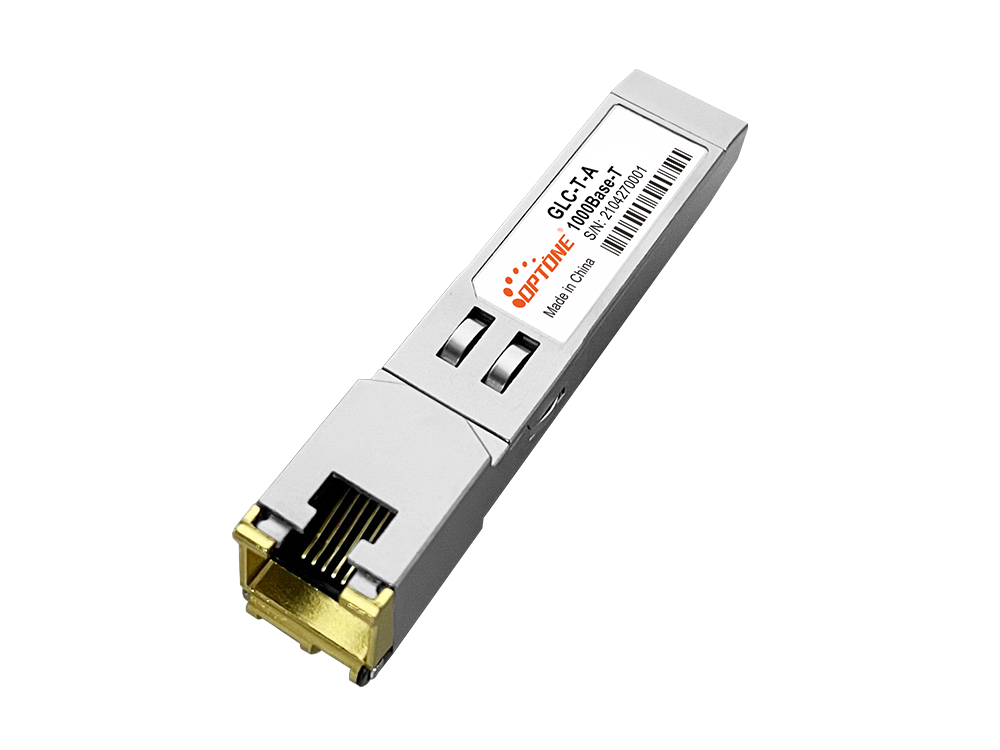
Converting Optical Ports to RJ45 Ethernet
The core function of a copper SFP is straightforward. It sits in an MSA-compliant optical cage, takes the serialized data passing through the switch backplane, and translates it into baseband signals for twisted-pair copper cable. The physical form factor remains identical to a standard fiber transceiver, but the optical laser assembly is replaced with an RJ45 jack and a PHY chip designed for electrical signaling.
Fixed-Rate vs. Auto-Negotiation Modules
Not all RJ45 SFP modules behave the same way on a network. The choice between fixed-rate and auto-negotiation dictates how the link initializes when you plug in a device.
- Fixed-Rate Modules (e.g., 1000BASE-T): These lock into a specific speed. If you buy a strict 1 Gigabit module, both ends of the link must natively operate at 1G. They offer slightly lower latency and faster link-up times because they skip the negotiation handshake entirely. Use these for switch-to-switch uplinks where port speeds are hardcoded.
- Auto-Negotiation Modules (10/100/1000BASE-T): These modules sense the speed of the connected device and adjust their rate accordingly. They are critical when patching into legacy equipment, out-of-band management interfaces, or edge devices where you cannot guarantee a strict Gigabit connection.
10GBASE-T Distance Limitations and Cable Standards
Moving from 1G to 10G changes the physics of your cabling. While standard optical transceivers can push a 10G signal across kilometers of single-mode fiber, a 10GBASE-T copper SFP+ is tightly constrained by signal degradation. Most standard 10G copper modules are rated for a maximum distance of 30 meters. This makes them strictly for intra-rack or adjacent-rack patching. If you try to push a 10G baseband signal across a 50-meter data center floor using a copper SFP+, the PHY chip will struggle to decode the attenuated signal, resulting in dropped packets and link failure.
Cat6a Requirements for 10G SFP+ Links
Pushing 10 Gigabits through an RJ45 SFP requires stringent cable specifications. Cat5e or standard Cat6 might link up at 10G over very short patch cords, but they are highly susceptible to alien crosstalk. For a stable 10GBASE-T connection, Cat6a or Cat7 cabling is mandatory. The thicker shielding and tighter wire twists in Cat6a mitigate the electromagnetic interference that disrupts high-speed electrical signaling.
Managing Power and Thermal Output in High-Density Switches
This is the specification buyers ignore until the switch throws a temperature alarm. Copper SFP+ modules draw significantly more power than their fiber equivalents.
A standard 10G short-reach fiber transceiver pulls roughly 1 watt of power. A 10GBASE-T copper SFP+ can draw between 2.5 and 3 watts, depending on the cable length and the internal chipset. That difference sounds small until you scale it.
If you populate every port on a 48-port 10G switch with copper SFP+ modules, you add over 100 watts of concentrated heat directly to the switch front panel. Most high-density switches are not engineered to cool that much localized heat. The standard field practice is to scatter copper modules across the switch fabric. Leave empty ports or insert cooler-running fiber transceivers between the copper modules to allow adequate airflow and prevent premature thermal throttling.
Deployment Scenarios for Copper SFP Modules
Optical Transceivers are usually associated with long-haul fiber, but copper variants solve specific local connectivity problems where running fiber is impractical.
- Connecting Legacy Management Ports: Core switches rely on SFP interfaces, but out-of-band management routers and console servers usually feature RJ45 ports. A 10/100/1000 auto-negotiation SFP bridges this hardware gap without requiring a separate management switch.
- End-of-Row Server Patching: If you have a fiber aggregation switch at the end of a row, but need to connect a handful of legacy servers equipped with standard Gigabit Ethernet NICs, adding a few copper SFP transceivers is far cheaper than deploying a dedicated top-of-rack copper switch.
- Phased Network Upgrades: During a transition from copper to fiber infrastructure, mixed media is inevitable. Copper modules give you the flexibility to patch existing copper runs into a new optical switch while waiting for the rest of the building’s fiber plant to be pulled.
Validating MSA Compliance and OEM Interoperability
The transceiver market is full of modules that look identical but fail to initialize when plugged into a Cisco, Juniper, or Arista switch. Switch vendors often check for specific EEPROM coding before enabling the port, locking out generic hardware.
Optone manufactures MSA-compliant optical transceivers, meaning the physical dimensions, electrical interfaces, and signaling follow the Multi-Source Agreement standards. Physical fit is only the baseline. For guaranteed interoperability, the module’s EEPROM must be coded to match the OEM’s expected signature. Every Optone module undergoes 100% functional testing in the factory. This guarantees it bypasses vendor lock-in warnings and links up exactly like a first-party transceiver, maintaining network stability without the excessive OEM markup.
Frequently Asked Questions
Can I use a 10G copper SFP+ in a 1G SFP port?
Generally, no. While some 10G modules can downshift to 1G, the physical 1G SFP port on older switches often cannot provide the required 2.5W+ of power, nor will the switch OS recognize the 10G EEPROM.
Do copper SFPs support DDM/DOM?
Unlike fiber modules, standard copper SFP transceivers typically do not support Digital Diagnostics Monitoring (DDM) or Digital Optical Monitoring (DOM). There are no laser bias currents or optical receive power levels to measure on a twisted-pair copper link.
Why is my 10G link dropping?
If your 10GBASE-T SFP+ drops packets, check the cable distance and grade first. Anything over 30 meters or lower than Cat6a is a primary suspect. Excessive heat from densely packed modules can also cause intermittent port shutdowns.
Requesting Application Notes and Datasheets
Selecting the right interface requires mapping your switch’s power limits, required distances, and specific OEM coding requirements. We provide full technical datasheets detailing power consumption, heat dissipation, and compatibility matrices for all our modules.
To verify which Optone copper SFP matches your current network hardware, contact our engineering team today to request the full Application Note or a factory-direct quote.
Need help selecting the right product?
Share your switch platform, link distance and quantity with an OPTONE engineer.
Talk to an Engineer →