
Legacy serial networks hit a hard physical wall. RS-232 maxes out around 50 feet before cable capacitance degrades the signal into unusable noise. RS-485 pushes that boundary to 4,000 feet, but stretching copper wire across a factory floor turns it into a massive antenna. Every variable frequency drive, heavy motor, and power line nearby induces noise into the communication cable.
Industrial facilities still rely heavily on these older serial protocols to run programmable logic controllers (PLCs), remote terminal units (RTUs), and motor drives. When those copper lines run between buildings or across long plant floors with different ground potentials, ground loops form. The resulting current runs straight up the communication wire and destroys expensive I/O cards. Copper serial connections cannot survive over long distances in high-noise environments without massive signal degradation or hardware failure.
Overcoming Distance and EMI Limits in Industrial Serial Communications
Replacing vulnerable copper runs with an industrial serial to fiber media converter removes the conductive path entirely. By converting the electrical serial signal into pulses of light, you break the circuit.
Glass fiber optic cable does not conduct electricity. It ignores high-voltage spikes, magnetic fields, and ground potential differences between remote sites. Running fiber alongside high-voltage transmission lines or heavy industrial machinery causes zero signal distortion.
Optical conversion also shatters the distance limitations of legacy copper. While RS-485 struggles past a few thousand feet, a fiber link can carry that same serial data for tens of kilometers without repeaters. Depending on the transceiver module selected, network engineers can even deploy the unit as a multi mode to single mode serial converter, bridging short plant-floor fiber runs with long-haul single-mode backbones spanning a municipal footprint.
How the OPT-277 Isolates and Transmits RS-232, RS-485, and RS-422 Signals
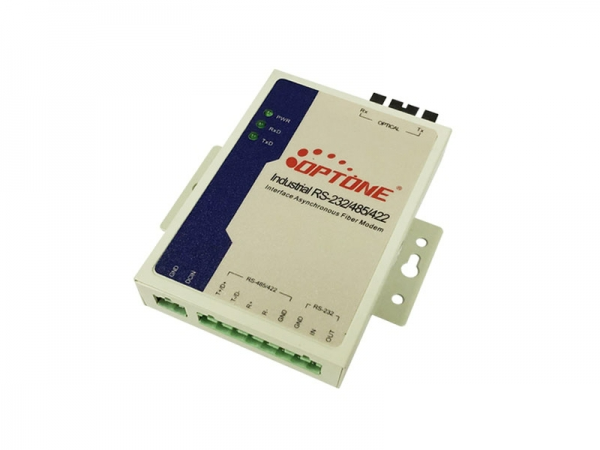
The OPTONE OPT-277 Series operates as a transparent optic fiber modem. Instead of forcing technicians to stock different hardware models for different legacy protocols, this single device handles all three major serial standards. It provides a direct physical-layer bridge that treats data strictly as raw signals rather than structured packets.
Transparent Optical Conversion with Zero Delay
Latency breaks legacy serial networks. Supervisory Control and Data Acquisition (SCADA) systems use strict master-slave polling architectures. Protocols like Modbus RTU rely on precise timing; if a message is delayed by even a few milliseconds, the master assumes the remote device is dead and drops the connection.
Many cheap protocol converters buffer incoming data, inspect the packet, and then retransmit it. That processing time introduces fatal latency. The OPT-277 functions entirely differently. It is a true zero delay serial fiber modem. It performs physical-layer conversion, translating the incoming electrical voltage directly to light and back again instantly. The transmission delay is effectively zero.
Because the data payload remains completely unaltered, protocol integrity and data privacy stay intact. The converter does not care if you are running Modbus, Profibus, or a proprietary vendor-specific protocol. The electrical state at one end is duplicated exactly at the other.
Plug-and-Play Configuration and Auto-Sensing Baud Rates
Field technicians waste hours configuring legacy serial equipment. Setting dip switches for baud rates, parity bits, and stop bits in a dark electrical cabinet frequently leads to costly setup errors and troubleshooting delays.
The rs232 rs422 rs485 fiber converter eliminates manual configuration. It detects and examines the signal speed automatically, locking onto the correct baud rate without human intervention. It also switches over automatically between RS-232, RS-422, and RS-485 inputs based on the active signal.
You wire the serial connections into the terminal block, connect your fiber optic cable, and apply power. No complex patch cord setup is required. This plug-and-play simplicity drastically reduces the time required to restore communication during emergency maintenance windows.
Deployment Scenarios for US Critical Infrastructure
American critical infrastructure runs on aging, highly reliable hardware that cannot simply be ripped out and replaced with Industrial Ethernet. Facilities need ways to securely extend the life of these systems.
Mitigating Electromagnetic Interference in Power Substations
Power substations are hostile to copper data lines. A switching event or a nearby lightning strike induces massive transient voltage onto any copper wire in the vicinity. If that wire connects a remote sensor to the central control room, the surge travels straight into the core SCADA servers.
Utility operators use a SCADA serial to fiber extension to isolate these systems. The OPT-277 provides total galvanic isolation. Even if a catastrophic lightning strike vaporizes a remote sensor, the surge cannot travel across the glass fiber. The control room equipment remains perfectly safe. The converter prevents the abominable electrical environment of a substation switchyard from threatening core communication equipment.
Integrating Legacy RS-485 PLCs with AI-Driven Predictive Maintenance Networks in 2026
As manufacturing facilities upgrade to advanced analytics and predictive maintenance models, they face a severe hardware gap. Modern cloud gateways require Ethernet or fiber inputs, but the machines generating the most critical telemetry are often thirty years old, outputting data via RS-485.
You cannot plug a legacy PLC directly into a modern analytics backbone. The OPT-277 serves as the physical bridge. Deployed as an rs485 to fiber optic transceiver, it allows legacy machine controllers to push raw serial data across new long-haul fiber runs. This allows plant managers to pull real-time data from 1990s-era machinery into 2026 predictive maintenance networks without replacing the underlying control hardware.
Hardware Protection and Surge Immunity in Harsh Environments
Commercial-grade IT equipment dies quickly in industrial settings. Wide temperature swings, conductive dust, and electrical transients destroy standard media converters in a matter of weeks.
OPTONE engineered the OPT-277 series specifically for dangerous environments. The internal circuitry includes dedicated isolation protection to handle wave surges and electromagnetic interference. The terminal blocks and internal pathways are hardened against voltage spikes that routinely fry consumer-grade serial ports.
When heavy industrial machinery starts up, it creates massive voltage sags and spikes on the local power grid. The OPT-277 maintains steady working conditions through these events. The device is built to survive in abominable conditions, ensuring that your serial link stays active when you need it most.
Sourcing OPTONE Industrial Converters for Enterprise Procurement
Finding reliable optical connectivity products at scale requires working with a manufacturer that actually controls its own production. OPTONE Technology Limited operates out of Shenzhen as a dedicated manufacturer of MSA-compliant optical transceivers, fiber media converters, AOC/DAC cables, and fiber Ethernet switches.
Procurement teams at telecom operators, ISPs, and industrial engineering firms rely on OPTONE for factory-direct pricing and ISO 9001 certified manufacturing quality. Buying direct bypasses the steep markups of third-party distributors while securing hardware built explicitly for harsh industrial networks.
When your infrastructure requires bridging legacy serial connections across high-noise environments without risking latency or hardware failure, the OPT-277 series provides the necessary isolation. Review the complete technical specifications, voltage tolerances, and supported fiber modes on the OPT-277 Series Fiber Media Converters page to plan your next network extension.
Need help selecting the right product?
Share your switch platform, link distance and quantity with an OPTONE engineer.
Talk to an Engineer →