
Picture a typical perimeter security upgrade. You have a light pole at the far edge of an industrial facility. It currently holds a single fixed IP camera, connected back to the main distribution frame (MDF) via a standard media converter and a long fiber run. Now, site security wants to add a Pan-Tilt-Zoom (PTZ) camera or an automatic license plate reader to that exact same pole.
You have two copper connections. You only have one fiber uplink.
Deploying edge hardware forces you to balance bandwidth requirements against physical site limitations. While standard Fiber Media Converters handle one-to-one connections perfectly, adding a second endpoint to an existing node usually triggers a cascade of costly infrastructure upgrades. You need a way to merge two copper signals onto one optical path without rebuilding the site.
The Challenge of Expanding Edge Camera Networks on Limited Fiber
Trenching new fiber to an existing pole costs thousands of dollars per hundred feet. It requires excavation permits, heavy machinery, and physical disruption to the site. If the existing underground conduit is full or collapsed, pulling a new multi-strand cable is out of the question.
Your default alternative is usually installing an industrial edge switch. You pull the old media converter, mount a 4-port Gigabit switch with an SFP slot inside the NEMA enclosure, and plug both cameras in. But this introduces new operational problems.
Switches generate more heat. They draw more power. They add management overhead and a new operating system to patch, secure, and monitor. Enclosure space is tight, and thermal management in a sealed outdoor box in July leaves little room for error. For two basic Fast Ethernet cameras, a full edge switch is an expensive, over-engineered fix that increases the site’s failure points.
How a Dual RJ45 to Fiber Converter Conserves Infrastructure
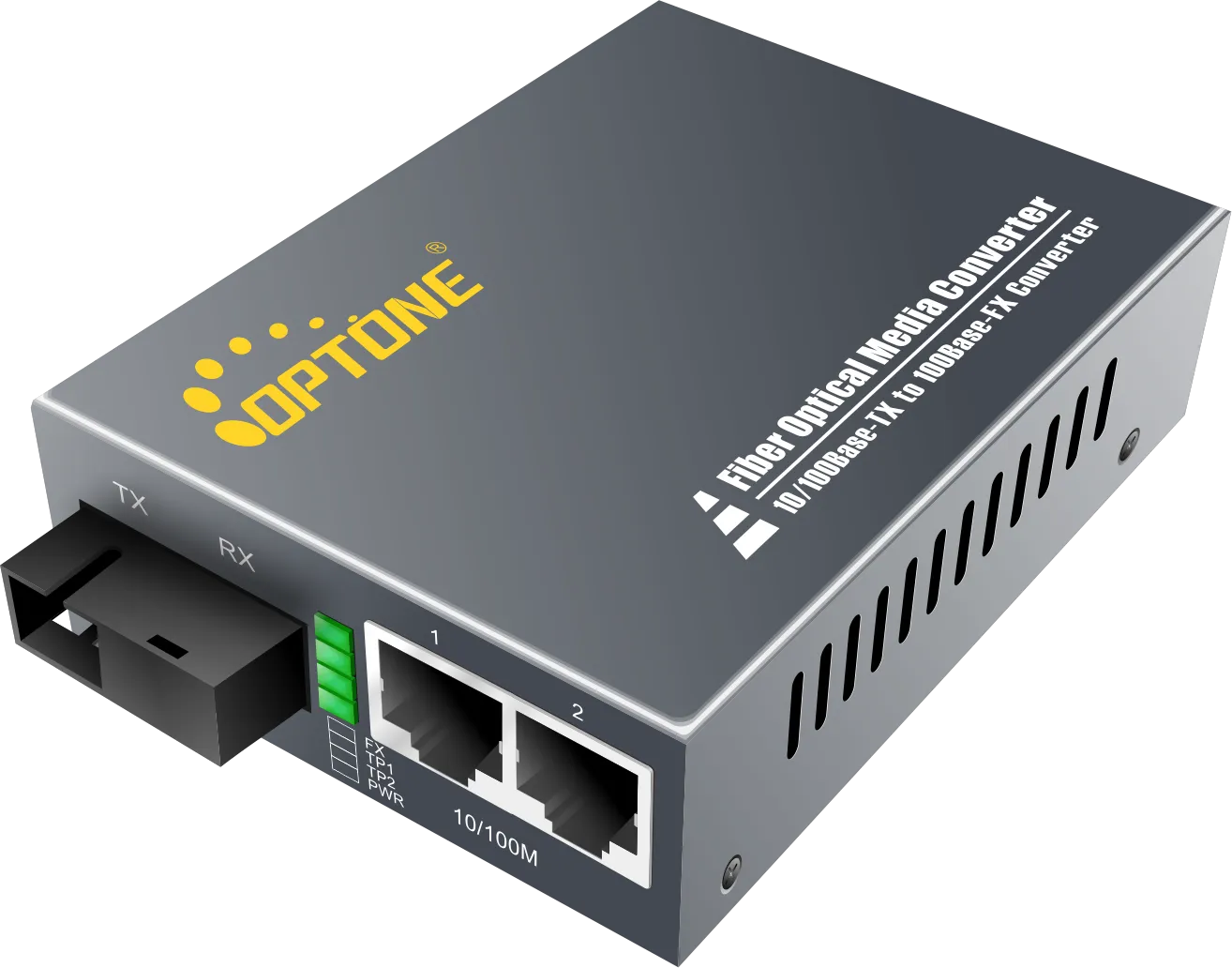
A 3-port 10/100M fast ethernet media converter solves the conduit problem at the hardware level. By offering two 10/100Base-TX copper ports and a single 100Base-FX optical port, it acts as a precise unmanaged bridge rather than a complex routing device.
Consolidating Two IP Cameras at a Single Edge Location
IP video surveillance rarely requires Gigabit speeds at the edge. Even modern 4K security cameras using H.265 compression typically output bitrates between 8 and 15 Mbps. Two of these cameras operating at maximum resolution will never saturate a 100Base-FX fiber uplink.
Using a 2 port RJ45 to 1 port fiber media converter allows you to plug both devices directly into a single unit. The internal switching IC multiplexes both copper signals onto the existing fiber strand. You save the cost of a new fiber pull, keep the hardware footprint small enough for standard enclosures, and maintain a low power draw that existing PoE midspans or localized power supplies can easily handle.
Securing Legacy 10/100 Endpoints in 2026 Zero-Trust Architectures
Security integrators often overlook how edge hardware interacts with modern network policies. If you install a managed switch at the pole, the core network sees the switch. You have just added a network infrastructure device outside your physical perimeter.
If you use an unmanaged 100Base-TX to 100Base-FX media converter, the connection remains completely transparent to the headend equipment. The core switch sees the MAC addresses of the two IP cameras directly. This means you can enforce port security, MAC filtering, or 802.1X authentication at the core MDF switch exactly the way you did before. The converter does not alter the packets or require its own IP address, eliminating a vulnerable administrative endpoint from your attack surface.
Bridging Fast Ethernet Over 120km with the OPT-1102 Series
Distance limitations are the primary reason fiber replaces copper in perimeter security. Standard Category 6 cable fails past 100 meters due to signal attenuation. The OPTONE OPT-1102 series pushes that boundary outward, delivering up to 120km of continuous connectivity per transmitted segment when using single-mode fiber.
That massive optical budget is critical for highway monitoring systems, border security, and sprawling solar farms where intermediate power sources simply do not exist. Achieving this distance requires precise calculation of your link budget before deployment.
Total Link Loss (dB) = (L × α) + (N × C) + (S × M) + Safety Margin

Where:
L = Fiber length in kilometers (e.g., 120km)
α = Fiber attenuation per km (typically 0.25 dB/km for 1550nm single-mode)
N = Number of connector pairs
C = Loss per connector (typically 0.3 dB to 0.75 dB)
S = Number of splices
M = Loss per splice (typically 0.1 dB)
Safety Margin = Standard 3 dB buffer for aging, bends, and temperature variations
If the combined loss exceeds the transmit power minus receiver sensitivity of the converter’s optical transceiver, the link will drop frames or fail to establish.
WDM Bi-Directional Transmission and Connector Flexibility
Maximizing limited fiber capacity means looking at how the light is transmitted. Traditional converters use dual fibers—one for transmitting (Tx) and one for receiving (Rx).
A WDM bi-directional fiber media converter halves your physical fiber requirement. Wavelength Division Multiplexing (WDM) uses specialized prisms to send and receive data simultaneously over a single strand of single-mode fiber by assigning different wavelengths to each direction (typically 1310nm and 1550nm). You install an “A” side unit at the MDF and a “B” side unit at the pole. If you only have one dark fiber left in the bundle, a WDM Simplex SC setup makes the dual-camera expansion possible.
OPTONE builds these units to order with ST, SC, or FC connectors. Specifying the correct connector at the factory prevents you from introducing unnecessary loss through adapter cables in the field.
Evaluating 3-Port Converters Against Gigabit Edge Switches
Engineers often default to buying small switches for everything. It pays to map out the actual trade-offs before drafting the bill of materials.
A 10/100 copper to fiber bridge requires zero configuration. You plug it in, and the link comes up. Edge switches require IP assignment, VLAN tagging, and firmware updates.
An industrial 4-port Gigabit switch with a separate SFP transceiver costs significantly more than an unmanaged 3-port fiber switch converter. When outfitting fifty perimeter poles, that price delta buys a lot of actual camera hardware.
Converters are simple state machines. They lack the complex ASICs and memory buffers of a switch. Fewer components mean a higher Mean Time Between Failures (MTBF). If a converter dies, a junior technician can swap it out in three minutes without downloading a config file.
The downside? You are hard-capped at 100 Mbps. If a future upgrade requires multi-sensor situational awareness cameras pushing 50 Mbps each, a Fast Ethernet uplink will bottleneck. You also lose SNMP monitoring at the edge; if the link goes down, you rely on the core switch to tell you the fiber is dark.
Sourcing OPTONE Converters for Physical Security Integration
Since 2003, OPTONE has manufactured optical connectivity products for telecom operators, data centers, and enterprise network engineers. The 2*10/100M TX and 1*100M FX configuration is engineered specifically for this kind of physical security infrastructure expansion.
Instead of dealing with gray-market resellers, integrators can source these units factory-direct. OPTONE builds MSA-compliant optical transceivers—adhering to the Multi-Source Agreement standards that guarantee interoperability across different OEM networking equipment without proprietary vendor lock-in. The converters are ISO 9001 certified and designed to integrate cleanly with 19-inch system chassis at the headend, keeping the server room organized while the edge devices sit miles away in extreme conditions.
Review the exact optical budgets, connector options, and WDM configurations for the OPTONE 2*10/100M TX and 1*100M FX converters to spec your next perimeter expansion accurately.
Need help selecting the right product?
Share your switch platform, link distance and quantity with an OPTONE engineer.
Talk to an Engineer →